 Primal Adapted
Magnetic Moment: From Cooling Rocks to Spinning Particles to the Living Body
From the field frozen into cooling lava to the spin of an electron, the MRI scanner and the iron in your blood, here is what researchers have measured, what they debate, and the less established ideas about magnetism and the body.
The Hidden Arrow Inside Everything
Every electron in your body carries a tiny built-in arrow. So does every proton in the water you drink, every grain of magnetite in a cooling lava flow, and the whole planet beneath your feet. That arrow is called a magnetic moment, and it ties the oldest rocks on Earth to the most precise measurements in physics and to the chemistry of your own blood.
You may have heard the phrase "magnetic moment" in a physics class, an MRI waiting room, or a video about pole shifts. It sounds abstract. It is actually one of the most concrete ideas in science: a measure of how strongly something behaves like a little magnet, and which way it points. Once you see what it is, the same idea shows up everywhere, at every scale, from a single quark-filled proton to a dead star with a field a hundred trillion times stronger than a fridge magnet.
This article climbs that ladder. It starts with a plain explanation of what a magnetic moment is. Then it follows the idea through rocks that froze the direction of Earth's field as they cooled, through the particles that make up atoms, through the quantum rules that split energy levels and make MRI possible, and finally into living tissue: hemoglobin, magnetite crystals in bacteria and brains, and the spin chemistry thought to guide migrating birds. Each idea is presented the way the people who study it describe it.
The article uses three labels throughout:
- Centralized View: the mainstream, well-replicated science.
- Middle Ground: published, peer-reviewed work that is real but still debated, small, or not yet tested in humans.
- Decentralized View: ideas outside the mainstream that have not been established.
Part 1: What a Magnetic Moment Actually Is
The arrow and its strength
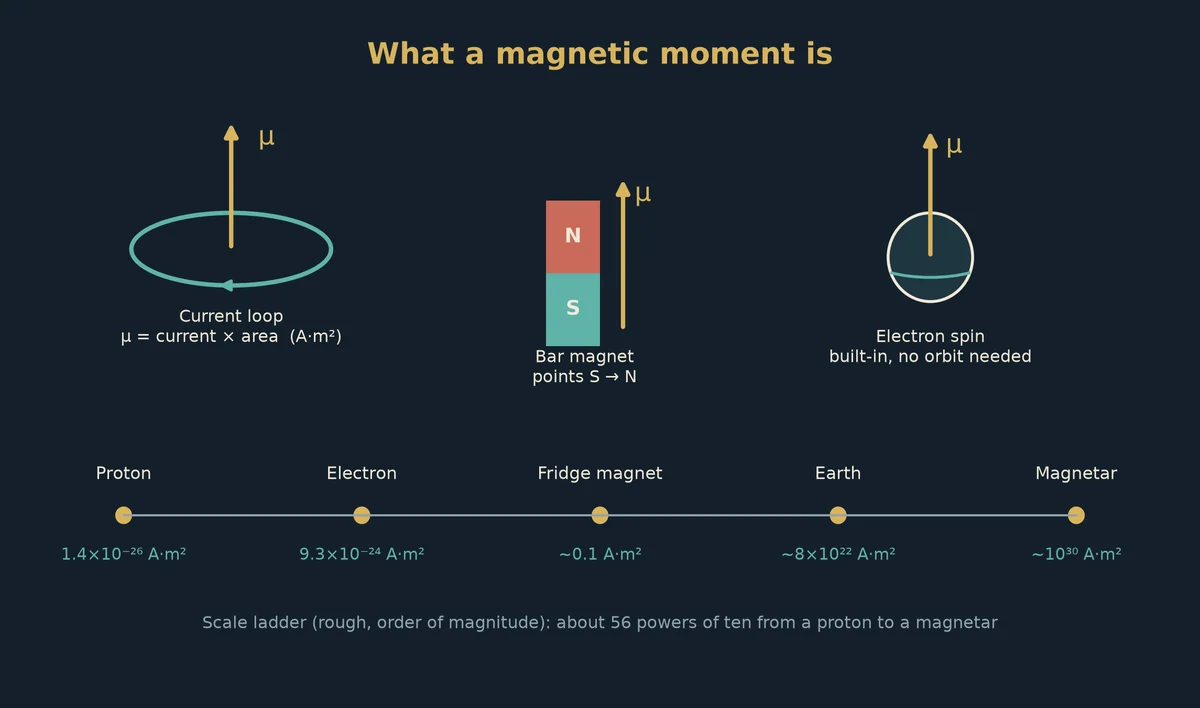
A magnetic moment is a vector. That means it has two parts: a size and a direction. The size tells you how strong a magnet the object is. The direction tells you which way its "north" points. Physicists write it with the Greek letter μ (mu).
The simplest picture is a loop of wire carrying an electric current. A current going around a loop makes a magnetic field that looks, from a distance, just like the field of a small bar magnet. The magnetic moment of the loop is the current multiplied by the area the loop encloses. That is why the standard unit is the ampere-square meter (A·m²). A bigger loop, or more current, means a bigger moment. The direction is set by a right-hand rule: curl the fingers of your right hand along the current, and your thumb points along the moment.
A bar magnet has a moment too. Its arrow runs from its south pole to its north pole inside the magnet. That is the same direction a compass needle settles into: a compass needle is simply a small magnetic moment free to turn.
Two kinds of moment: orbital and intrinsic
For a long time physicists assumed all magnetism came from moving charges, the current-loop picture. In atoms, an electron moving around the nucleus does act like a tiny current loop. That gives the orbital magnetic moment.
But electrons, protons and neutrons also carry a moment that has nothing to do with orbiting. It is built in, like mass or charge. It is tied to a quantum property called spin. In 1925 George Uhlenbeck and Samuel Goudsmit proposed that the electron carries its own angular momentum and its own magnetic moment, to explain patterns in atomic spectra. This intrinsic or spin moment is not a little ball literally spinning; no classical spinning ball could produce it. It is a property of the particle itself, and it only takes two values when measured along any direction: "up" or "down."
In most materials around you, the total magnetism comes from adding up the spin and orbital moments of the electrons, with smaller contributions from nuclei.
What a moment does in a field: energy, torque and wobble
Three simple rules describe how any magnetic moment behaves in an outside magnetic field (written B, measured in tesla):
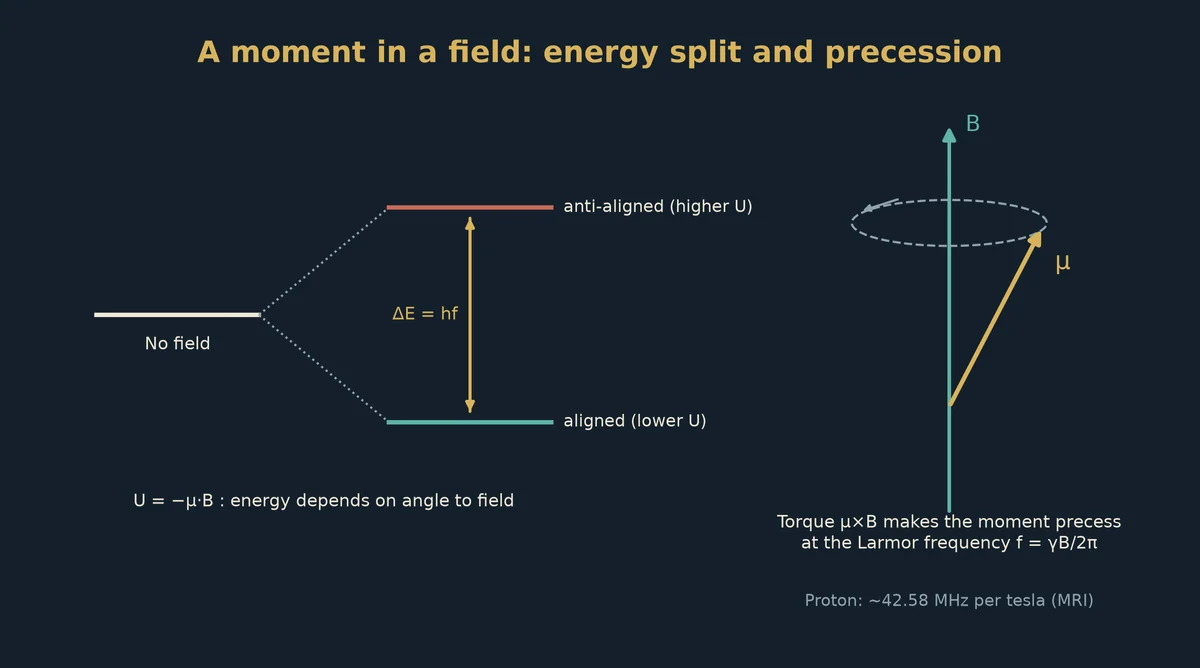
1. Energy. The energy of the moment is U = −μ·B. It is lowest when the moment points along the field and highest when it points against it. That is why a compass needle settles pointing north.
2. Torque. If the moment is at an angle to the field, the field twists it with a torque equal to μ × B. That twist tries to line the moment up.
3. Precession. If the object also has angular momentum, as every spinning particle does, the torque does not simply flip it into line. Instead the moment circles around the field direction, like a tilted spinning top circling around the vertical. This circling is called Larmor precession, and its rate is proportional to the field strength.
A fourth rule matters for rocks and planets: in a field that changes from place to place, a moment feels a net push toward stronger or weaker field. That push is how Otto Stern and Walther Gerlach split a beam of silver atoms in 1922, as described below.
Three kinds of magnetic material
How a material responds to a field depends on how its electrons' moments are arranged:
- Diamagnetic materials have all their electrons paired, so their spin moments cancel. In a field, their electron orbits shift slightly to create a weak moment pointing against the field. Water, most organic molecules, and therefore most of the human body are weakly diamagnetic.
- Paramagnetic materials have unpaired electrons whose moments point in random directions. In a field they line up a little, adding a weak moment along the field. Heat keeps knocking them out of line, so the effect is weaker at higher temperatures. Oxygen gas (O₂) is paramagnetic.
- Ferromagnetic and ferrimagnetic materials, such as iron and magnetite, have neighboring electron moments locked together by a quantum effect called exchange. Huge numbers of moments point the same way inside regions called domains. These materials can hold a strong moment even with no field present. That memory is what rocks use to record the ancient field.
Why some atoms are magnetic and others are not
Inside an atom, electrons fill shells according to the Pauli exclusion principle: no two electrons can share every quantum property, so two electrons in the same orbital must have opposite spins. Opposite spins mean opposite moments, and the pair cancels. That is why most molecules in living things, with all their electrons paired, carry no net spin moment.
Atoms with partly filled shells are different. Chemists use Hund's rule, which says electrons spread out across orbitals of equal energy with their spins pointing the same way before they start pairing up. Iron, cobalt, nickel and many rare-earth elements end up with several unpaired electrons, all pointing together. That is the source of their large atomic moments. Whether those atomic moments then lock together into a ferromagnet depends on how neighboring atoms interact in the solid.
The orbital part of the moment is often partly "quenched" in solids. The electric fields of neighboring atoms pin the electron orbits in place, so they cannot freely line up with an outside field. In many iron compounds, including the iron in hemoglobin, the measured moment is close to what the spins alone would give. That is why Pauling and Coryell could count unpaired electrons from a single magnetic measurement, as described later.
Oxygen: the magnetic molecule you breathe
Ordinary oxygen gas is one of the few common molecules with unpaired electrons. Molecular orbital theory explains that the O₂ molecule's last two electrons sit alone in two separate orbitals with parallel spins. Its ground state is therefore a "triplet," with a net spin moment, and liquid oxygen is visibly pulled toward the poles of a strong magnet, a classic chemistry demonstration. Nitrogen, which fills its orbitals in pairs, is not. This triplet nature is also why oxygen reacts slowly with most organic matter at room temperature: most biological molecules are singlets, with all spins paired, and spin rules make direct reactions between a triplet and a singlet unlikely.
The scale ladder
Magnetic moments span an enormous range. Rounded to their order of magnitude:
- A proton: about 1.4 × 10⁻²⁶ A·m².
- An electron: about 9.3 × 10⁻²⁴ A·m², roughly 660 times bigger than a proton's.
- A small fridge magnet: around a tenth of an A·m².
- Earth: about 8 × 10²² A·m².
- A magnetar, a type of neutron star: around 10³⁰ A·m² or more, with surface fields thought to reach about 10¹⁰ to 10¹¹ tesla.
The same rule, U = −μ·B, applies all the way up and down this ladder.
Pillar 1: Centralized View: the established science
Centralized View
Rocks that remember: thermoremanent magnetization
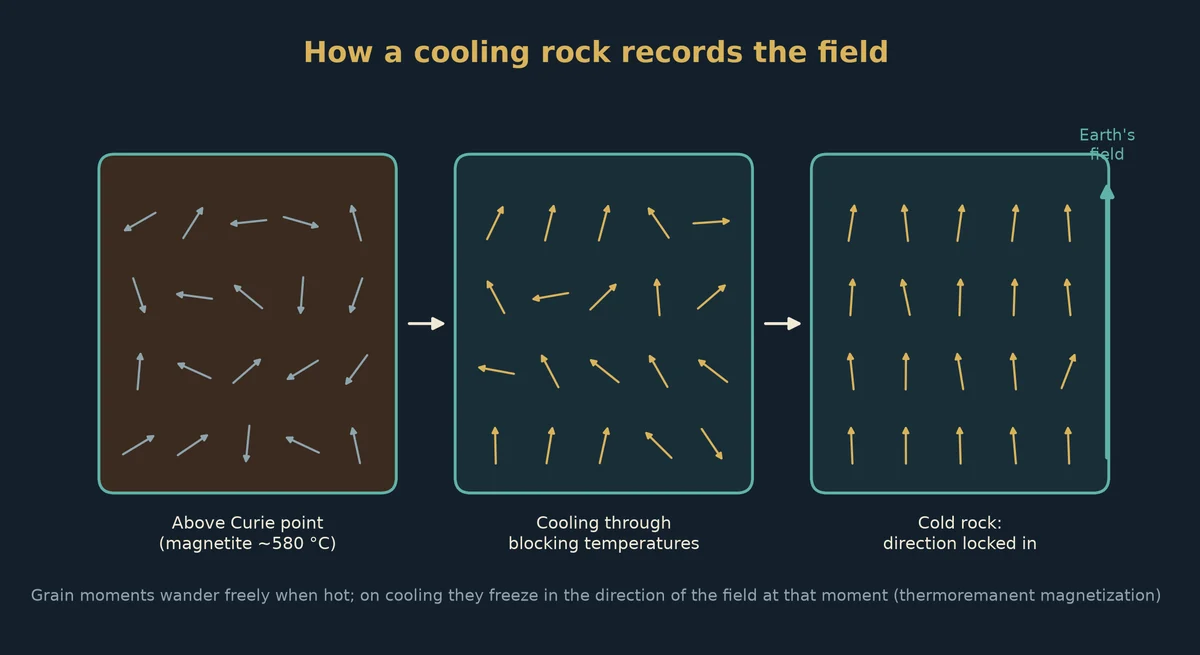
Volcanic rocks such as basalt carry small grains of iron oxide minerals, especially magnetite (Fe₃O₄) and titanium-rich versions of it. When lava is hot, the moments inside each grain are scrambled by heat. Above a temperature called the Curie point, about 580 °C for pure magnetite, the material cannot hold any lasting magnetization at all.
As the rock cools below the Curie point, each grain's domains start to hold their order. Each grain also has its own blocking temperature, below which its moment can no longer flip easily by heat. The moments lock in while Earth's field is gently nudging them, so slightly more of them freeze pointing along the field than against it. The result is a weak but extremely stable net moment in the rock, pointing in the direction of the field at the time of cooling. Geophysicists call this thermoremanent magnetization (TRM). In fine single-domain grains it can survive for hundreds of millions of years.
Sediments record the field too, in a different way. As small magnetic grains settle through water, they tend to rotate toward the field before they are buried. This is called detrital or depositional remanent magnetization.
What rock moments tell us about Earth
Because each rock keeps a compass reading from the moment it formed, geologists can read three things from it:
- Direction. The tilt of the recorded moment (its inclination) depends on latitude. Near the equator the field is nearly horizontal; near the poles it is nearly vertical. So the tilt in an old rock tells you roughly what latitude it formed at. This is one of the key tools that showed continents have moved.
- Polarity. Some rocks point the "wrong" way, magnetized opposite to today's field. In the early twentieth century, French physicist Bernard Brunhes and later Japanese geophysicist Motonori Matuyama reported reversely magnetized volcanic rocks. Today it is established that Earth's field has flipped polarity hundreds of times.
- Strength. With careful lab heating experiments, researchers can estimate how strong the ancient field was. This is called paleointensity.
The seafloor tape recorder
In 1963 Fred Vine and Drummond Matthews published "Magnetic anomalies over oceanic ridges" in Nature. They proposed that the striped magnetic patterns on either side of mid-ocean ridges come from new seafloor forming at the ridge, cooling, and recording the field, then moving outward. When the field reversed, the next strip of crust recorded the opposite polarity. The mirror-image stripes became one of the strongest lines of evidence for seafloor spreading and plate tectonics.
Earth's own magnetic moment
Earth as a whole has a magnetic moment of about 8 × 10²² A·m². Most of the field at the surface looks like a giant dipole, as if a bar magnet sat near the center, tilted about 10 degrees from the spin axis. Geophysicists explain it with the geodynamo: churning, electrically conducting liquid iron in the outer core generates and sustains the field.
Earth's dipole moment is not constant. Measurements going back to the first direct field surveys in the 1830s and 1840s show that it has decreased by about 9 percent since 1840, roughly 5 percent per century. Short events called excursions happen too. In the Laschamp excursion, about 41,000 years ago, global field models place the field at a small fraction of its present strength for a short time before it recovered without fully reversing.
Researchers have asked whether today's weakening means a reversal is coming. A 2018 study in PNAS by Brown and colleagues, titled "Earth's magnetic field is probably not reversing," compared the present field with reconstructions of past excursions and concluded that today's pattern does not resemble the start of those events.
Mars: a planet that lost its moment
Mars does not have a global dipole field today. In 1999 Mario Acuña and the Mars Global Surveyor magnetometer team reported in Science that the planet's crust nonetheless carries strong, patchy magnetization, concentrated in the ancient cratered southern highlands and missing from giant impact basins such as Hellas and Argyre. The team concluded that Mars once had a core dynamo that shut down early in its history. Its rocks recorded the field while it existed, and the youngest large basins formed after it was gone. In this view, Martian rocks are a fossil of a planetary magnetic moment that no longer exists.
Reading a rock's moment in the lab
Paleomagnetists drill small cores from rock outcrops and mark their orientation before removing them. In a magnetically shielded lab, they measure each core's moment with sensitive magnetometers, often superconducting ones. Rocks can pick up later "overprints," for example from lightning strikes or from slow reheating. To strip them away, researchers demagnetize samples step by step, by heating or with alternating fields, and watch which part of the moment survives. The most stable part, removed only at the highest steps, is usually taken as the original record. Comparing many sites and ages builds a timeline of reversals, called the geomagnetic polarity time scale, which is now used to date rocks and sediments worldwide.
Atoms in a magnet: Stern and Gerlach
In 1922 Otto Stern and Walther Gerlach sent a beam of silver atoms through a magnet whose field was stronger on one side than the other. If each atom's moment could point any direction, the beam should have smeared into a band. Instead it split cleanly into two spots. Each silver atom has one unpaired electron, and its moment could only be "up" or "down" along the field. This was the first direct sight of what is now called spatial quantization, and it later became the standard textbook demonstration of electron spin.
The electron's moment and the number g
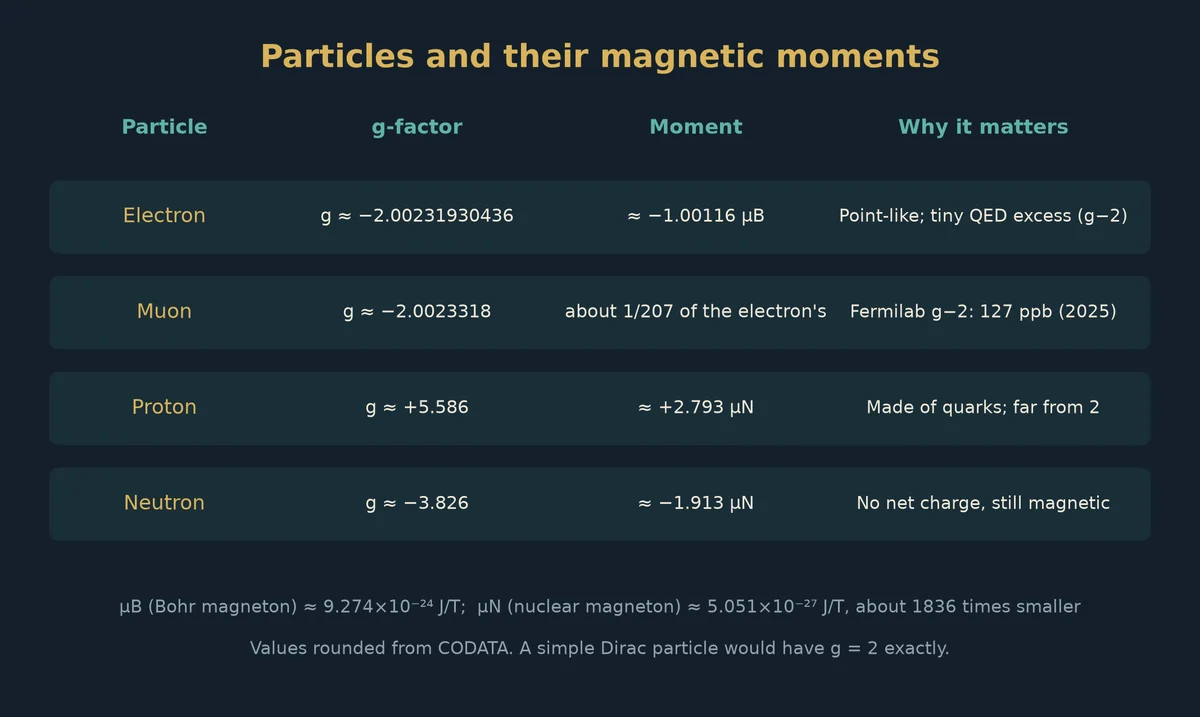
Physicists describe a particle's moment by comparing it with a basic unit. For electrons the unit is the Bohr magneton, μB, about 9.274 × 10⁻²⁴ joules per tesla. A number called the g-factor says how big the moment is compared with that unit, given the particle's spin.
Paul Dirac's 1928 theory of the electron predicted g = 2 exactly. Real electrons come out slightly bigger. In 1948 Julian Schwinger published "On Quantum-Electrodynamics and the Magnetic Moment of the Electron" in Physical Review. He showed that the electron's interaction with the quantum vacuum, the constant flicker of virtual photons around it, raises the moment by a fraction equal to α/2π, about 0.00116, where α is the fine-structure constant. That small excess is called the anomalous magnetic moment, written (g − 2)/2.
In 2023 Xing Fan, Thomas Myers, Benedict Sukra and Gerald Gabrielse reported in Physical Review Letters a measurement of the electron's moment using a single electron held for months in a Penning trap. They found g/2 = 1.001 159 652 180 59, with an uncertainty of 0.13 parts per trillion. The team describes it as the most precisely determined property of any elementary particle, and as a test of the Standard Model's most precise prediction to about one part in a trillion. Asked by Science News about the pull of such a precise prediction, Gabrielse said: "It's irresistible to some of us."
The muon: a heavier electron under the microscope
The muon is like an electron but about 207 times heavier. Because it is heavier, its moment is far more sensitive to heavy particles flickering in the vacuum, including any that physics has not yet discovered. That made the muon's g − 2 a prime place to hunt for new physics.
The Muon g−2 experiment at Fermilab stored polarized muons in a 14-meter-wide ring with a 1.45-tesla field and measured how fast their spins precessed. On June 3, 2025 the collaboration released its third and final result: a value of 0.001 165 920 705, with a precision of 127 parts per billion, surpassing its design goal. Spokesperson Peter Winter told Physics: "The experimental value stands now on very solid footing."
For several years the measurement appeared to disagree with the theoretical prediction. In 2025 the Muon g−2 Theory Initiative's updated prediction, which relies on lattice calculations of the strong-force contribution, agreed with experiment within its error bars. Thomas Blum of the University of Connecticut, a contributor to the theory initiative, told Physics: "It seems likely that the g − 2 puzzle has been resolved."
Protons and neutrons: moments from quarks
For nuclear particles the natural unit is the nuclear magneton, μN, about 5.05 × 10⁻²⁷ joules per tesla. It is about 1,836 times smaller than the Bohr magneton because the proton is about 1,836 times heavier than the electron.
If the proton were a simple point particle like the electron, its moment would be about 1 μN. Instead it is about 2.79 μN. The neutron has no net electric charge, so a simple theory would give it no magnetic moment at all. Instead it has about −1.91 μN. These "wrong" values were early clues that protons and neutrons are not elementary. In the quark model, each is built from three quarks with their own charges and moments, and the simple quark model predicts a neutron-to-proton moment ratio close to −2/3, close to the measured value of about −0.68.
Nuclei and the road to MRI
Many atomic nuclei carry a net spin and therefore a magnetic moment: hydrogen-1 (a single proton), carbon-13, phosphorus-31, sodium-23 and others. In a strong magnetic field, a nucleus's spin can only line up in certain allowed ways, and each orientation has a slightly different energy. This is the nuclear version of the Zeeman effect, the splitting of energy levels in a field.
The gap between levels matches a radio frequency equal to the Larmor frequency. For the proton it is about 42.58 megahertz per tesla, so about 128 megahertz in a 3-tesla clinical scanner. Send in radio waves at exactly that frequency and the nuclei absorb energy and flip; switch the radio off and they give the energy back as a faint signal while they precess. That is nuclear magnetic resonance (NMR). Felix Bloch and Edward Purcell demonstrated it in bulk matter in 1946.
MRI uses the moments of the hydrogen nuclei in the body's water and fat. Gradient coils make the field vary slightly from place to place, so each spot in the body precesses at its own frequency. Computers then turn those frequencies into a picture.
The search for an electric arrow: the neutron EDM
A neutron is a magnetic compass. Physicists also want to know whether it is a tiny electric compass, with an electric dipole moment (EDM): a slight separation of positive and negative charge inside it. A nonzero neutron EDM would break both mirror symmetry and time-reversal symmetry, and could help explain why the universe holds more matter than antimatter.
In 2020 a collaboration at the Paul Scherrer Institute (PSI) in Switzerland reported the most precise measurement yet in Physical Review Letters, using ultracold neutrons and a mercury-199 comagnetometer to track the magnetic field. The result was (0.0 ± 1.1 ± 0.2) × 10⁻²⁶ e·cm, consistent with zero. The experiment had to correct for magnetic disturbances as small as those made by trucks passing on the nearby road. PSI physicist Philipp Schmidt-Wellenburg said in the institute's release: "So it has become less likely that the neutron will help explain the excess of matter. But it still can't be completely ruled out."
Reading moments across the universe: sunspots and the 21-centimeter line
Magnetic moments let astronomers measure fields they can never touch. In a magnetic field, the energy levels of atoms split by the Zeeman effect, so a single spectral line in starlight or sunlight splits into several closely spaced lines. In 1908 the American astronomer George Ellery Hale used this splitting to show that sunspots hold strong magnetic fields, the first detection of a magnetic field beyond Earth. Astronomers still use Zeeman splitting to map fields on the Sun and other stars.
A second cosmic signal comes from the smallest moment pairing of all. In a hydrogen atom, the electron's spin moment and the proton's spin moment can point the same way or opposite ways. The parallel arrangement has very slightly more energy. When the electron flips to the lower state, the atom gives off a radio photon with a wavelength of about 21 centimeters, at about 1,420 megahertz. Each atom flips only rarely, but there is so much hydrogen in space that the signal is strong. Harold Ewen and Edward Purcell first detected it in 1951, and radio astronomers have used it ever since to map the spiral arms of the Milky Way and the motion of gas in distant galaxies. A flip between two tiny moments inside one atom became one of the main tools for seeing the structure of the universe.
Stars and magnetars
Moments grow enormous at stellar scales. The Sun's large-scale field flips polarity about every 11 years with the sunspot cycle. Neutron stars squeeze the magnetic field of a collapsed star into a ball about 20 kilometers across, which concentrates it enormously. Magnetars are neutron stars with the strongest known fields, on the order of 10¹⁰ to 10¹¹ tesla at the surface, which makes them the top rung of the moment ladder.
Biology I: blood is magnetic in two ways
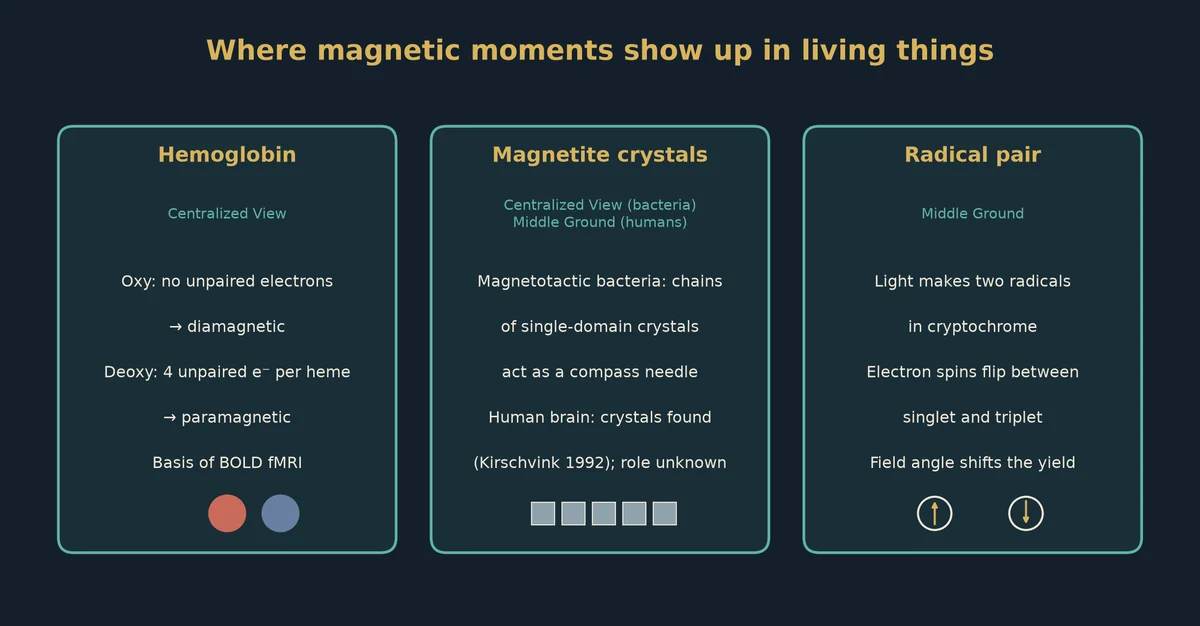
In 1936 Linus Pauling and Charles Coryell measured the magnetism of blood with a Gouy balance, weighing samples in and out of a magnetic field. They reported in PNAS that oxyhemoglobin and carbonmonoxyhemoglobin have no unpaired electrons and zero magnetic moment, so they are diamagnetic. Deoxygenated hemoglobin, by contrast, has four unpaired electrons per heme and is paramagnetic, with an effective moment of about 5.46 Bohr magnetons per heme.
Free oxygen gas has two unpaired electrons, so Pauling and Coryell had expected it might keep them when bound. Their data showed otherwise. In their words: "The oxygen molecule undergoes a profound change in electronic structure on combination with hemoglobin."
That difference between arterial and venous blood became the basis of functional MRI. In 1990 Seiji Ogawa and colleagues reported in PNAS that paramagnetic deoxyhemoglobin acts as a natural MRI contrast agent. They named the effect blood oxygenation level-dependent (BOLD) contrast. When a brain region becomes active, blood flow rises, the share of deoxyhemoglobin drops, and the MRI signal changes. Nearly every "brain lighting up" image from fMRI rests on the magnetic moment of iron in hemoglobin.
Biology II: bacteria that carry compass needles
In 1975 Richard Blakemore reported in Science that certain bacteria in marine sediments swim along magnetic field lines. These magnetotactic bacteria build chains of magnetite or greigite crystals inside membrane sacs called magnetosomes. Each crystal is sized to be a single magnetic domain, and the chain adds their moments into one strong arrow. The whole cell is twisted into line by the field like a compass needle, and even dead cells align. The bacteria are thought to use this to steer up and down toward their preferred oxygen level.
Pillar 2: Middle Ground: active and contested research
Middle Ground
Magnetite in the human brain
In 1992 Joseph Kirschvink, Atsuko Kobayashi-Kirschvink and Barbara Woodford reported in PNAS that human brain tissue contains magnetite. Using an ultrasensitive superconducting magnetometer in a clean lab, they estimated at least 5 million single-domain crystals per gram in most brain tissues and more than 100 million per gram in the membranes around the brain (the pia and dura). The crystals looked much like those made by magnetotactic bacteria and fish. The authors wrote that this biogenic magnetite might explain some MRI effects and, perhaps, some biological effects of low-frequency magnetic fields.
Chemical & Engineering News reported at the time that the work was met with some skepticism and that Kirschvink said several journals had rejected it without review before PNAS accepted it. Today the presence of magnetite in human brain tissue is widely accepted. What it does there, and how much comes from the body versus outside pollution, is still debated.
A cautionary tale: the pigeon's beak
For years, a leading idea held that birds sense the field through iron-rich nerve endings in the upper beak. In 2012 Christoph Treiber and colleagues reported in Nature that the clusters of iron-rich cells in the pigeon's upper beak are macrophages, a type of immune cell, not magnetosensitive neurons. Their number varied hugely from bird to bird, and they lacked the markers of nerve cells. The finding did not rule out a magnetite-based sense elsewhere in the body, but it showed how hard it is to locate one, and it shifted more attention toward the radical-pair route.
The radical-pair compass
Many migratory birds sense the direction of Earth's field. One leading explanation does not use magnetite at all. It uses the spin moments of single electrons.
In 2000 Thorsten Ritz, Salih Adem and Klaus Schulten proposed in Biophysical Journal that light absorbed by a protein in the bird's eye creates a radical pair: two molecules, each with one unpaired electron. The two electron spins start out correlated, in a "singlet" or "triplet" state, and they swap between those states over about a millionth of a second. Earth's field is extremely weak, but it can slightly change the rate of that swapping depending on the angle between the molecule and the field. That changes how much of each chemical product forms, which in principle gives the bird a direction signal.
Peter Hore and Henrik Mouritsen reviewed the mechanism in 2016 in the Annual Review of Biophysics. The leading candidate protein is cryptochrome. In 2021 Jingjing Xu and colleagues reported in Nature that cryptochrome 4 from the European robin, a night-migrating songbird, shows magnetic sensitivity in the lab, more than the same protein from chickens and pigeons.
Researchers still debate how the bird's brain reads the signal, and how a field so weak, about 50 microtesla, can produce a reliable effect inside a warm, noisy cell. That is why it sits here in the Middle Ground.
Do humans respond to Earth's field?
In 2011 Lauren Foley, Robert Gegear and Steven Reppert reported in Nature Communications that human cryptochrome 2, when expressed in fruit flies lacking their own cryptochrome, could restore a light-dependent magnetic response in the flies.
In 2019 Connie Wang, Kirschvink and colleagues reported in eNeuro that rotating an Earth-strength field around people sitting in a shielded, dark room caused a drop in alpha-band brain waves in some participants, depending on the direction of rotation. They interpreted it as evidence that the human brain transduces geomagnetic field changes. Whether this reflects a usable human magnetic sense, and through which mechanism, remains open.
Spin chemistry in the cell
The radical-pair idea is not limited to bird eyes. Many reactions inside cells, including some in mitochondria and in the making of reactive oxygen species, pass through pairs of radicals. Laboratory spin chemistry shows that magnetic fields can change the yields of some radical reactions in solution. Researchers are studying whether weak fields have measurable effects on such reactions inside living cells, and results so far are mixed.
Pillar 3: Decentralized View: ideas not yet established
Decentralized View
Magnetism, healing and "the body electric"
Orthopedic surgeon Robert O. Becker, in his 1985 book The Body Electric written with Gary Selden, argued that living tissue runs partly on direct-current electrical signals that guide healing and regeneration, and that outside electromagnetic fields can interfere with them. Becker's work on electrical currents in limb regeneration was published research. His wider view, that the body's electrical and magnetic environment is a central organizer of health, is held by a smaller group and has not been established.
Magnets on the body
Static magnets sold as bracelets, insoles and pads are promoted by some practitioners to improve circulation or reduce pain. The usual claim is that a magnet pulls on iron in the blood. Supporters point to hemoglobin's magnetism. Mainstream physicists answer that blood is only weakly paramagnetic or diamagnetic, as Pauling and Coryell measured, so a small magnet produces almost no force on it. Controlled trials of such products have not shown consistent benefits.
A body tuned to Earth's field
Some writers in the ancestral-health and grounding community describe the body as an antenna tuned to Earth's natural field and to the Schumann resonances, and argue that time spent indoors, on concrete, or in man-made fields detunes it. These writers often cite the cryptochrome research and the Wang 2019 alpha-wave result as support. The researchers behind those papers have not made claims about health effects in people.
A fast-weakening field and a coming excursion
Ben Davidson, who runs the Suspicious0bservers channel and the S0 News program, argues that Earth's magnetic field is weakening faster than official models show, and that a geomagnetic excursion linked to a recurring cycle of solar and Earth catastrophes may be approaching. Other researchers who track the field, including the authors of the 2018 PNAS study above, describe the measured decline as about 5 percent per century and do not find that the present field resembles the lead-up to past excursions.
The Magnetic Moment and the Living Body: Tying the Scales Together
The same rule at every scale Centralized View
The physics of a magnetic moment does not change between a proton and a planet. Energy, torque and precession follow the same equations. What changes is the size of the moment, the size of the field, and how strongly heat scrambles things.
That last part matters most for biology. At body temperature, the thermal energy of a molecule is about 4 × 10⁻²¹ joules. The energy of a single electron's moment in Earth's 50-microtesla field is about 5 × 10⁻²⁸ joules, roughly ten million times smaller. A single spin in Earth's field therefore cannot simply be "lined up" against heat. That is why mainstream researchers look to two special tricks for magnetic sensing in life: large groups of locked-together moments, as in magnetite, and short-lived quantum spin states, as in radical pairs, where the field changes a rate rather than an alignment.
Moments as messengers Centralized View
In medicine, nuclear moments are already the body's most-used messengers. Each MRI scan reads the precession of hydrogen nuclei. fMRI reads the switch of iron in hemoglobin between zero and about five Bohr magnetons. Electron spin resonance, a cousin of NMR, reads unpaired electrons in radicals and metal centers in proteins.
The body's own magnetic moments: the heart and brain Centralized View
The body does not only respond to magnetic moments; it makes them. Every nerve and heart-muscle cell that fires drives a tiny electric current, and every current loop has a magnetic moment. Added together across millions of cells, these currents produce magnetic fields outside the body. They are extremely weak. The heart's field at the chest surface is on the order of a hundred picotesla, about a millionth of Earth's field, and the brain's is around a hundred times weaker still, in the femtotesla range.
Physicist David Cohen pioneered measuring these fields in magnetically shielded rooms, first for the heart and then for the brain, and the arrival of superconducting quantum interference devices (SQUIDs) made the measurements practical. Today magnetoencephalography (MEG) uses arrays of such sensors to track brain activity millisecond by millisecond, and newer optically pumped magnetometers can sit right on the scalp. Each MEG recording is, at bottom, a measurement of the summed magnetic moment of synchronized currents in the brain's neurons, read against the backdrop of Earth's field, which is millions of times larger and must be shielded out.
Electron paramagnetic resonance (EPR), also called electron spin resonance, is the electron version of NMR. It flips unpaired electron spins with microwaves instead of radio waves. Biochemists use it to detect free radicals and to study metal centers in proteins, including the iron-sulfur clusters and copper sites in the mitochondrial respiratory chain, where electrons pass one at a time and spend brief moments unpaired.
Moments as sensors Middle Ground
The radical-pair and magnetite routes give two candidate ways a living thing could feel Earth's moment: a quantum spin compass and a mineral compass needle. Both are well supported in some animals and unresolved in humans.
Moments as a whole-body organizer Decentralized View
The broadest claims, that the body's health is organized by its magnetic and electrical environment and that modern life breaks that link, connect these threads into a single picture. That picture has not been tested as a whole.
The whole picture at a glance
| Scale | What the magnetic moment does | Level |
|---|---|---|
| Current loop, bar magnet | Moment = current × area; arrow from S to N | Centralized View |
| Energy, torque, precession | U = −μ·B; torque μ × B; Larmor precession | Centralized View |
| Cooling volcanic rock | Locks in field direction below Curie and blocking temperatures (TRM) | Centralized View |
| Seafloor stripes | Record reversals and seafloor spreading | Centralized View (Vine and Matthews 1963) |
| Sunspots, 21-cm hydrogen line | Zeeman splitting and spin flips map cosmic fields and gas | Centralized View |
| Earth's dipole | About 8 × 10²² A·m², down about 9% since 1840 | Centralized View |
| Field reversal soon | Present field not like past excursions | Centralized View (Brown et al. 2018) |
| Mars crust | Fossil record of a dynamo that shut down | Centralized View (Acuña 1999) |
| Pigeon beak iron cells | Immune cells, not a magnetic sensor | Centralized View (Treiber 2012) |
| Silver atoms in a magnet | Beam splits in two: quantized moments | Centralized View (Stern and Gerlach 1922) |
| Electron g-factor | Measured to 0.13 parts per trillion | Centralized View (Fan et al. 2023) |
| Muon g−2 | Final result 127 ppb; theory now agrees | Centralized View (Muon g−2 2025) |
| Proton and neutron moments | Set by quark structure | Centralized View |
| Neutron EDM | Consistent with zero | Centralized View (Abel et al. 2020) |
| NMR and MRI | Hydrogen nuclei precess at about 42.58 MHz per tesla | Centralized View |
| Hemoglobin | Oxy diamagnetic, deoxy paramagnetic; basis of BOLD fMRI | Centralized View (Pauling and Coryell 1936; Ogawa 1990) |
| Magnetotactic bacteria | Magnetite chains act as compass needles | Centralized View (Blakemore 1975) |
| Magnetite in human brain | Present; role unclear | Middle Ground (Kirschvink 1992) |
| Radical-pair compass | Strong in birds; cryptochrome 4 sensitive in lab | Middle Ground (Ritz 2000; Xu 2021) |
| Human geomagnetic response | Alpha-wave changes in some people | Middle Ground (Wang 2019) |
| Body as an electromagnetic system | Fields organize healing and health | Decentralized View (Becker) |
| Static magnets for health | Claimed circulation and pain benefits | Decentralized View |
| Fast field collapse | Excursion approaching | Decentralized View (Davidson) |
Not yet verified
These points have not been established, or were not checked against a primary source for this draft, and should be read as open questions:
- That humans have a working magnetic sense, or that one runs through cryptochrome or magnetite.
- What biogenic magnetite does in the human brain, and how much of it is made by the body.
- That weak magnetic fields change radical-pair reactions in human mitochondria in a way that matters for health.
- That static magnets worn on the body improve circulation or reduce pain.
- That the body is "tuned" to Earth's field or the Schumann resonances, or that indoor living detunes it.
- That Earth's field is weakening faster than published models show, or that an excursion is near.
- Exact years and primary papers for the Brunhes and Matuyama reversal reports, the 1928 Dirac g = 2 prediction, and the 1946 Bloch and Purcell NMR papers (stated from standard histories; not re-checked for this draft).
- Hale's 1908 sunspot Zeeman discovery and Ewen and Purcell's 1951 detection of the 21-centimeter line (standard history; primary papers not opened for this draft).
- David Cohen's early heart and brain magnetic recordings (dates and papers not opened for this draft), and the approximate heart and brain field strengths.
- The magnetar moment and field values and the fridge-magnet moment in the scale ladder (order-of-magnitude estimates).
- The bibliographic details of Becker and Selden's The Body Electric (1985) and Davidson's specific claims, which are paraphrased from secondary summaries.
- The page range of Treiber et al. 2012 and Acuña et al. 1999 (journal and DOI checked; pages from memory).
- The 2025 Muon g−2 Theory Initiative paper itself (agreement reported by Physics; the primary paper was not opened for this draft).
This article presents viewpoints, attributed to their sources. It is not medical advice.
Key sources
- Uhlenbeck GE, Goudsmit S (1925). Proposal of electron spin. Naturwissenschaften 13.
- Gerlach W, Stern O (1922). Zeitschrift für Physik 9:349–352.
- Schwinger J (1948). On quantum-electrodynamics and the magnetic moment of the electron. Physical Review 73:416. https://doi.org/10.1103/PhysRev.73.416
- Fan X, Myers TG, Sukra BAD, Gabrielse G (2023). Measurement of the electron magnetic moment. Physical Review Letters 130:071801. https://doi.org/10.1103/PhysRevLett.130.071801
- Conover E (2023). Electrons' magnetism confirms particle physics' most precise prediction. Science News. https://www.sciencenews.org/article/standard-model-particle-physics
- Muon g−2 Collaboration (2025). Measurement of the positive muon anomalous magnetic moment to 127 ppb. Physical Review Letters. https://doi.org/10.1103/7clf-sm2v
- Fermilab (June 3, 2025). Muon g-2 announces most precise measurement of the magnetic anomaly of the muon. https://news.fnal.gov/2025/06/muon-g-2-most-precise-measurement-of-muon-magnetic-anomaly/
- Physics 18, 116 (2025). Muon experiment calls it a wrap. https://physics.aps.org/articles/v18/116
- Abel C et al. (2020). Measurement of the permanent electric dipole moment of the neutron. Physical Review Letters 124:081803. https://doi.org/10.1103/PhysRevLett.124.081803
- Paul Scherrer Institute (2020). Tracking down the mystery of matter. https://www.psi.ch/en/news/media-releases/tracking-down-the-mystery-of-matter
- Vine FJ, Matthews DH (1963). Magnetic anomalies over oceanic ridges. Nature 199:947–949.
- Brown M, Korte M, Holme R, Wardinski I, Gunnarson S (2018). Earth's magnetic field is probably not reversing. PNAS 115:5111–5116. https://doi.org/10.1073/pnas.1722110115
- Pauling L, Coryell CD (1936). The magnetic properties and structure of hemoglobin, oxyhemoglobin and carbonmonoxyhemoglobin. PNAS 22:210–216. https://doi.org/10.1073/pnas.22.4.210
- Ogawa S, Lee TM, Kay AR, Tank DW (1990). Brain magnetic resonance imaging with contrast dependent on blood oxygenation. PNAS 87:9868–9872. https://doi.org/10.1073/pnas.87.24.9868
- Blakemore R (1975). Magnetotactic bacteria. Science 190:377–379. https://doi.org/10.1126/science.170679
- Kirschvink JL, Kobayashi-Kirschvink A, Woodford BJ (1992). Magnetite biomineralization in the human brain. PNAS 89:7683–7687. https://doi.org/10.1073/pnas.89.16.7683
- Acuña MH et al. (1999). Global distribution of crustal magnetization discovered by the Mars Global Surveyor MAG/ER experiment. Science 284:790–793. https://doi.org/10.1126/science.284.5415.790
- Treiber CD et al. (2012). Clusters of iron-rich cells in the upper beak of pigeons are macrophages not magnetosensitive neurons. Nature 484:367–370. https://doi.org/10.1038/nature11046
- Ritz T, Adem S, Schulten K (2000). A model for photoreceptor-based magnetoreception in birds. Biophysical Journal 78:707–718.
- Hore PJ, Mouritsen H (2016). The radical-pair mechanism of magnetoreception. Annual Review of Biophysics 45:299–344. https://doi.org/10.1146/annurev-biophys-032116-094545
- Xu J et al. (2021). Magnetic sensitivity of cryptochrome 4 from a migratory songbird. Nature 594:535–540.
- Foley LE, Gegear RJ, Reppert SM (2011). Human cryptochrome exhibits light-dependent magnetosensitivity. Nature Communications 2:356.
- Wang CX et al. (2019). Transduction of the geomagnetic field as evidenced from alpha-band activity in the human brain. eNeuro 6:ENEURO.0483-18.2019.
- Becker RO, Selden G (1985). The Body Electric: Electromagnetism and the Foundation of Life. William Morrow.
This article is for education only and is not medical advice. Talk with a doctor or other qualified clinician before using magnets, magnetic devices, or any other therapy, and tell your care team about any implants or metal before an MRI.
Better signals, less noise.
One email a week: the best threads on light, Earth cycles and sovereignty, with context, evidence labels and links to the original sources.
Thanks! You're on the list.
Sorry, something went wrong. Please try again, or reach us on X at @primal_buddha.
No spam. Unsubscribe anytime.