 Primal Adapted
The Quantum Biophysics of Cancer
A deep dive into cancer through genes, mitochondria, tissue organization, water, isotope effects, spin chemistry and the Decentralized View, with clear evidence boundaries.
What Makes a Cell Become a Cancer Cell?
Put a cancer cell under a microscope and its DNA is only one part of the scene. Around the nucleus sit mitochondria, folded membranes, moving ions, water, proteins and neighboring cells. Electrons cross molecular distances. Protons move through channels. Oxygen changes chemical partners. The cell maintains electrical differences across its surfaces. Nothing in that picture operates separately from everything else.
Two cells carrying cancer-associated mutations need not behave alike. Their tissues, mitochondrial populations, differentiation states and immune surroundings can change what those mutations do. Certain laboratory experiments go further: malignant behavior can be reduced by changing extracellular architecture or mitochondrial context without repairing the nuclear sequence. Whether water organization, light exposure and quantum processes can explain those changes is a further question, not something those experiments establish by themselves.
That is the starting point for this article. Is cancer primarily a disease of altered genetic instructions? A breakdown of metabolism and tissue-level control? Or, in the Decentralized View, a failure of the physical conditions that normally allow a multicellular body to hold its cells in a coordinated state?
The article uses three labels throughout:
- Centralized View the mainstream framework of genetic, molecular and evolutionary oncology, including its established understanding of metabolism, tissue context and immunity.
- Middle Ground published work on mitochondrial causality, tissue organization, bioelectricity and circadian regulation, with evidence ranging from established mechanisms to model-specific findings and disputed interpretations.
- Decentralized View the wider synthesis that places water organization, light, isotope handling, spin chemistry and collective electromagnetic behavior upstream of malignant transformation. Its components have different levels of support; the complete causal chain has not been clinically established.
These are reading guides, not formal scientific affiliations. Douglas Wallace, Michael Levin, Thomas Seyfried, Gerald Pollack, Jiří Pokorný and Jack Kruse do not constitute one school, and discussing connections among them does not mean they endorse one another's conclusions.
Medical context: this is a comparison of mechanisms and research programs, not a cancer-treatment guide. None of the proposed water, light, isotope or field mechanisms below is a reason to delay diagnosis, abandon oncology care or replace treatment with a self-directed intervention.
Pillar 1: Centralized View — Genes, Selection and the Tumor Ecosystem
Centralized View
From chromosomes to drivers and passengers
The chromosome-centered account is historically associated with Theodor Boveri. Modern oncology does not require every cancer to begin with one particular chromosome abnormality. It asks how heritable changes allow a cell lineage to survive and expand under conditions that ordinarily restrict growth. The exact chronology of Boveri's original argument was not checked against his monograph for this draft; that historical detail remains in the verification section.
The Somatic Mutation Theory (SMT) places acquired, heritable alterations in the cell lineage at the center of tumor development. Contemporary genetic oncology includes epigenetic states and tissue selection rather than requiring DNA sequence to act independently of its surroundings.
A driver change contributes to that advantage. A passenger change travels with the expanding lineage without necessarily helping it. The distinction depends on context: a mutation useful in one tissue may be neutral or harmful in another. Cancer genomes also contain rearrangements, copy-number changes and epigenetic alterations, not simply single-letter substitutions.
KRAS can keep growth signaling active. MYC can amplify transcriptional programs supporting biomass production. TP53 helps coordinate responses to cellular stress, while RB1 constrains cell-cycle entry. BRCA1 and BRCA2 participate in DNA repair by homologous recombination. Altering these functions can change the probability that damaged cells persist, divide and acquire further changes. The genes do not act as isolated switches; they operate in networks with feedback and redundancy.
Fearon and Vogelstein's 1990 colorectal model linked progression through recognizable lesions to accumulating genetic changes [4]. The sequence was not a universal timetable for every cancer. Its importance was to connect tissue pathology with successive alterations in growth control, rather than ask one mutation to explain the entire disease.
The hallmarks are capabilities, not a claim that DNA acts alone
Hanahan and Weinberg's 2000 framework described recurring capabilities acquired during tumor development: sustained proliferation, evasion of growth suppression and cell death, replicative persistence, blood-vessel recruitment, and invasion and metastasis [1]. Their 2011 update incorporated altered energetics and immune evasion, alongside genome instability and tumor-promoting inflammation [2]. Hanahan's 2022 extension discussed phenotypic plasticity, nonmutational epigenetic reprogramming, microbiomes and senescent cells [3].
These frameworks describe what tumors accomplish. They do not establish that every capability has one genetic origin, or that tissue and metabolic influences are secondary in every case. Contemporary oncology studies fibroblasts, immune cells, extracellular matrix, oxygen delivery, metabolites and mechanical forces precisely because malignant cells depend on their surroundings.
Clonal evolution adds time. A tumor contains related but nonidentical populations. Treatment changes selection pressures; resistant populations may expand through pre-existing alterations, acquired alterations or reversible cellular states. The Cancer Genome Atlas revealed extensive molecular diversity, but diversity is not itself a contradiction of evolutionary models. Those models expect multiple routes to similar advantages.
The Warburg effect does not mean all mitochondria have stopped
The Warburg effect is increased conversion of glucose to lactate despite available oxygen. Lactate dehydrogenase regenerates NAD⁺ from NADH, allowing glycolysis to continue. FDG-PET uses uptake and trapping of a glucose analogue to identify metabolically active tissue. Uptake is neither unique to cancer nor equally strong in every cancer: inflammation can also produce a signal.
In Vander Heiden, Cantley and Thompson's account, dividing cells need more than ATP [6]. They need carbon for nucleotides, amino acids and lipids, and reducing power for biosynthesis. PI3K–AKT–mTOR signaling promotes nutrient uptake and growth. MYC supports glucose and glutamine use. HIF-1α can increase glycolytic machinery and restrict pyruvate oxidation. Pentose phosphate pathway activity supplies ribose and NADPH.
A high lactate-production rate can coexist with functioning mitochondria. DeBerardinis and Chandel describe tumors that use the tricarboxylic acid cycle, electron transport, glutamine oxidation and other fuels extensively [7]. Different regions of one tumor can exchange metabolites. Some resistant or metastatic populations depend strongly on oxidative phosphorylation.
This distinction matters throughout the article. A cancer cell can be highly glycolytic without having a universally collapsed mitochondrial voltage. Some cancers maintain or increase mitochondrial membrane potential. Neither lactate nor FDG uptake alone identifies the initiating defect, and neither establishes that a cell has reverted to a purely fermentative state.
Where the genetic account has causal leverage
BCR–ABL in chronic myeloid leukemia provides a direct example: a chromosomal rearrangement creates an abnormal kinase, and imatinib inhibition of that kinase can produce major clinical responses. Resistance mutations can alter drug binding. Targeted inhibitors in other molecularly selected cancers similarly connect an altered protein with a therapeutic vulnerability. These examples support gene-level causality without implying that every cancer is equally targetable.
Inherited repair defects provide another line of evidence. A germline alteration can elevate cancer risk across generations through a defined biological pathway. Immunotherapy supplies a different connection: mutation-derived peptides can be presented to immune cells, although response also depends on antigen presentation, immune access, checkpoint signaling and the tumor ecosystem.
These successes are not proof that genes are sufficient in every setting. They show that particular genetic alterations can be functional causes and treatment targets. A metabolic or tissue-level account must accommodate them, just as genetic oncology must accommodate cases in which context substantially changes the behavior of a mutated lineage.
The findings critics ask this framework to explain
Martincorena and colleagues found positively selected cancer-associated mutations in normal human skin in 2015 and extensive mutant clones in aging esophagus in 2018 [8,9]. A tissue can contain mutations commonly associated with cancer without being a cancer. The experiments separate a selected clone from invasive malignant disease.
For tissue-centered researchers, this makes the organizing environment central. For genetic researchers, it shows that mutation combinations, cell identity, competition, exposure history and immune surveillance affect penetrance. Both readings recognize that the presence of a driver is not equivalent to a completed tumor.
Reports of tumors with few identifiable coding drivers raise another issue. A negative coding panel cannot exclude structural changes, noncoding drivers, epigenetic mechanisms, low-purity sampling or undiscovered drivers. No specific near-zero-driver tumor series was directly verified for this draft, so no numerical claim is made. The narrower, supported point is that a sequence alone is not a complete description of malignancy.
Pillar 2: Middle Ground — Metabolism, Tissue Organization and Electrical Control
Middle Ground
Warburg's respiratory-injury argument and Seyfried's extension
Warburg's 1956 paper placed impaired respiration upstream of compensatory fermentation [5]. His earlier metabolic work is discussed historically in the sources; the original 1920s report was not directly inspected here. Today's disagreement is not whether aerobic glycolysis occurs, but whether irreversible respiratory injury explains cancer generally.
Seyfried's 2015 synthesis treats cancer primarily as a mitochondrial metabolic disease [10]. In his account, chronic respiratory insufficiency reorganizes redox balance, energy production and growth signaling. Nuclear mutations can accumulate as consequences and then reinforce the phenotype. Glucose and glutamine become major supports for survival and proliferation.
The glutamine component needs biochemical precision. Glutamine can feed α-ketoglutarate into the TCA cycle. Conversion of succinyl-CoA to succinate can generate GTP or ATP through succinyl-CoA synthetase: mitochondrial substrate-level phosphorylation. This reaction is distinct from oxidative phosphorylation and does not itself consume oxygen. Sustaining the surrounding pathway still requires carbon flow and redox accounting. Describing all glutamine metabolism as fermentation would obscure those requirements.
Kiebish, Han, Cheng, Chuang and Seyfried found cardiolipin and electron-transport abnormalities in mouse brain-tumor mitochondria [11]. Their lipidomic results connect membrane composition with respiratory function. They do not establish one universal cardiolipin lesion in all human cancers or show that changing dietary fat repairs an established malignancy.
What cytoplasmic transfer actually tests
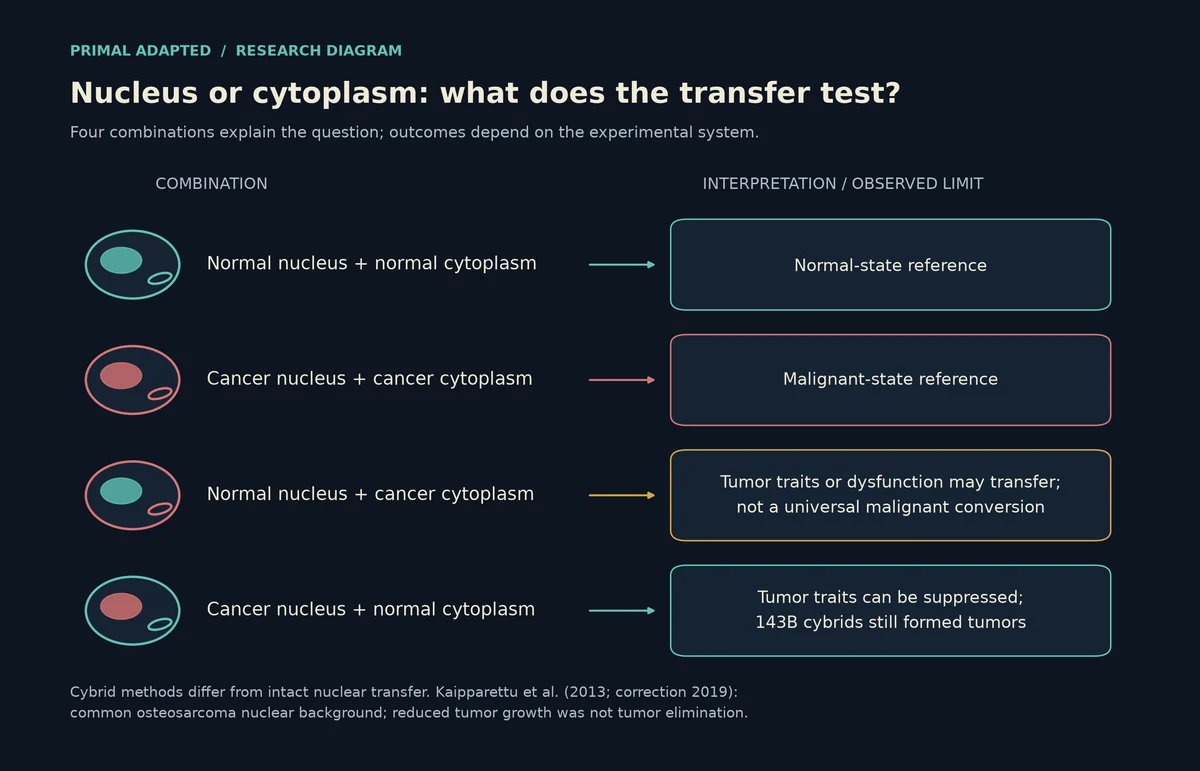
A cybrid, or cytoplasmic hybrid, allows investigators to compare mitochondrial backgrounds while holding a nuclear background relatively constant. It is not always a literal isolated nucleus dropped into a different intact cell. Methods may deplete mitochondrial DNA and then fuse recipient cells with enucleated mitochondrial donors. Selection, residual organelles and compatibility between nuclear and mitochondrial genomes all matter.
Seyfried discusses older transfer studies associated with Israel and Schaeffer, Howell and Sager, and Koura. Their original experimental details were not directly checked here. They are not treated as four universally reproducible crosses proving that a normal nucleus always becomes malignant in tumor cytoplasm, or a malignant nucleus always becomes harmless in normal cytoplasm.
The directly checked Kaipparettu study used a common 143B osteosarcoma-derived nuclear background and mitochondrial donors from noncancerous or cancerous cell lines [12]. Noncancerous donor mitochondria increased several respiratory measurements and reduced invasion, anchorage-independent growth and tumor growth relative to the cancer-mitochondria comparison.
An important sentence in the primary report is: “As expected, all cybrids formed tumors under the highly tumorigenic and metastatic 143B nuclear background.” Suppression was not equivalent to elimination. The 2019 correction replaced incorrectly assembled immunoblot panels and noted that some underlying data were unavailable [13]. Both the finding and correction belong in the account.
Ishikawa and colleagues separately showed that particular ROS-generating mitochondrial DNA mutations could influence metastatic behavior in experimental cells [14]. Transfer effects establish that mitochondria can change malignant properties in a particular system. They do not make nuclear genes irrelevant or demonstrate that mitochondrial transplantation is an established cancer treatment.
Wallace: metabolism can write back to the nucleus
Wallace's account emphasizes bioenergetics, mitochondrial DNA and communication between cellular compartments [15]. A cell contains many mitochondrial genomes. Heteroplasmy means more than one mitochondrial sequence is present; the fraction and distribution of variants can affect physiology. Mitochondrial changes can modify electron transport, ROS, calcium handling, apoptosis and nuclear gene expression without changing nuclear DNA sequence.
The connection to chromatin is chemically specific. TET DNA-modifying enzymes and JmjC histone demethylases use α-ketoglutarate and oxygen. Succinate and fumarate can oppose α-ketoglutarate-dependent reactions. Mutant IDH enzymes produce 2-hydroxyglutarate, an oncometabolite that can alter demethylation. Acetyl-CoA supplies acetyl groups for histone modification. NAD⁺ is consumed by sirtuins and PARP enzymes involved in regulation and repair.
HIF prolyl hydroxylases also depend on oxygen and α-ketoglutarate. Their inhibition can stabilize hypoxia signaling even when oxygen is present: pseudohypoxia. Gomes and colleagues' 2013 paper examined declining NAD⁺ and disrupted nuclear–mitochondrial communication during aging [16]. It was not a demonstration that NAD⁺ supplementation prevents or cures human cancer.
This is a concrete route from metabolism to gene regulation. It is also compatible with genes acting upstream: an IDH mutation can alter a metabolite that changes chromatin. The direction can run both ways, which is why retrograde signaling does not by itself settle whether the first lesion was genetic, metabolic or environmental.
Tissue organization: Soto, Sonnenschein and Bissell
Soto and Sonnenschein's Tissue Organization Field Theory places the primary explanatory level in tissue relationships [17]. They treat proliferation and motility as cellular defaults requiring constraint, rather than assume an isolated cell's natural state is permanent quiescence. Cancer, in their framing, develops when reciprocal communication between tissue components fails.
Here field means an organizing domain of tissue interactions; it does not automatically mean an electromagnetic field. Matrix architecture, stromal–epithelial signaling and physical organization can form such a domain. This differs from Pokorný's electromagnetic proposal even though both discuss organization beyond DNA sequence.
In Bissell's research program, three-dimensional culture changes what breast epithelial cells can express. Weaver and colleagues reported reversion of malignant features through integrin-blocking interventions in a three-dimensional setting [18]. Polarity, cytoskeletal organization and growth behavior responded to altered matrix signaling. Phenotypic reversion is not proof that every genomic alteration vanished or that the same intervention cures human tumors.
Mintz and Illmensee's 1975 work showed that cells from a malignant teratocarcinoma context could contribute to normal tissues in genetically mosaic mice [19]. The embryonic environment could organize developmental behavior differing from tumor growth. Developmentally plastic teratocarcinoma cells are not interchangeable with every adult carcinoma. The experiment demonstrates contextual developmental capacity, not universal reversibility.
Levin: voltage as a regulator of cellular decisions
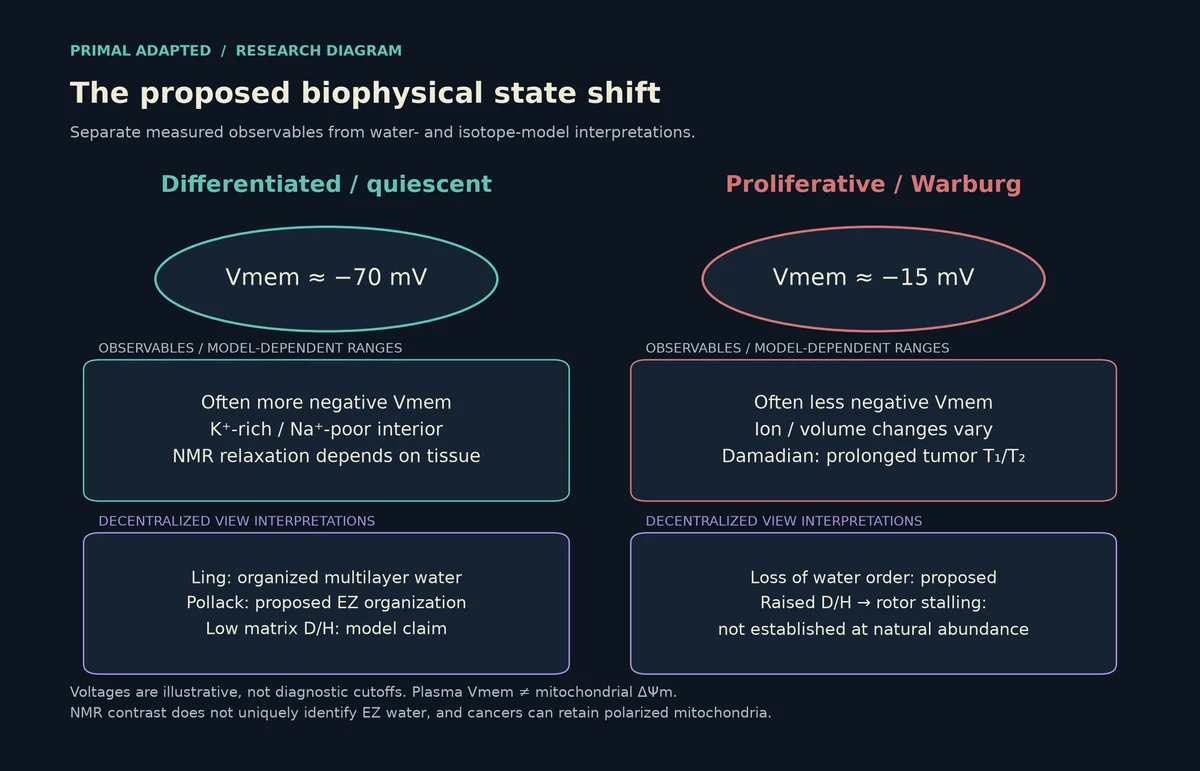
The plasma-membrane potential, Vmem, is the voltage between a cell's inside and outside. It is separate from mitochondrial ΔΨm. Ion channels, transporters, pumps and gap junctions establish and distribute it. Many differentiated cells are comparatively hyperpolarized, and many proliferating cells are less negative, but cell-type ranges overlap and voltage changes during the cell cycle.
Values near −70 mV and −15 mV are useful illustrations, not diagnostic boundaries. Neurons, muscle, epithelia, stem cells and cancers do not share one resting-voltage table. Clarence Cone's 1971 theoretical paper linked transmembrane potential with mitotic control [20]; later experiments ask which ion-mediated pathways make that association causal.
Chernet and Levin's 2013 Xenopus study used oncogene-induced tumor-like structures to test bioelectric detection and intervention [21]. Voltage changes could mark sites before visible masses, and manipulating ion-channel activity could reduce tumor-like outcomes despite the oncogenic input. Related Levin-group work, including Blackiston and Lobikin, explores non-neural electrical regulation of pigmentation, proliferation and anatomy. Specific optogenetic cancer-reversal protocols were not directly verified here.
In the Chernet–Levin study, the mechanistic screen implicated the voltage-regulated transporter SLC5A8 and butyrate, a histone-deacetylase inhibitor. Other bioelectric work examines calcium entry, second messengers, serotonin signaling and gap-junction communication. The specific pathway must be identified in each model. A channel intervention is not simply electricity replacing genetics. It changes biochemical signaling downstream of voltage. These are developmental and experimental cancer models; they do not establish a clinical protocol for electrically normalizing a patient's tumor.
Circadian timing and Blask's nighttime-blood experiment
Light can affect cancer biology through a sensory–endocrine route without photons reaching a tumor. Retinal signaling entrains the circadian system; nighttime melatonin carries information about darkness. Core clock machinery interacts with cell-cycle timing, DNA repair, metabolism and immune activity.
Blask and colleagues perfused human breast-cancer xenografts grown in nude rats with blood collected from premenopausal women under different lighting conditions [22]. Blood obtained during nighttime darkness carried melatonin-associated growth inhibition. Blood collected after nighttime light exposure lost that inhibitory character. The model linked the signal to tumor linoleic-acid uptake and production of the mitogenic metabolite 13-HODE.
The broader Blask program connects MT1 receptor signaling with metabolic regulation, including aerobic glycolysis. The 2005 experiment should not be made to carry every later claim by itself. Its direct contribution is the controlled connection among light exposure of human donors, circulating nighttime signals and a perfused xenograft's response.
IARC classifies night shift work as Group 2A, a probable human carcinogenic hazard [42]. That classification combines human, animal and mechanistic evidence; it is not a prediction that a particular night of light exposure causes cancer. It also does not establish melatonin pills as cancer treatment. Circadian disruption is one contributor in a larger risk and disease landscape.
Pillar 3: Decentralized View — The Physical State Beneath the Pathways
Decentralized View
A map of the proposed causal order
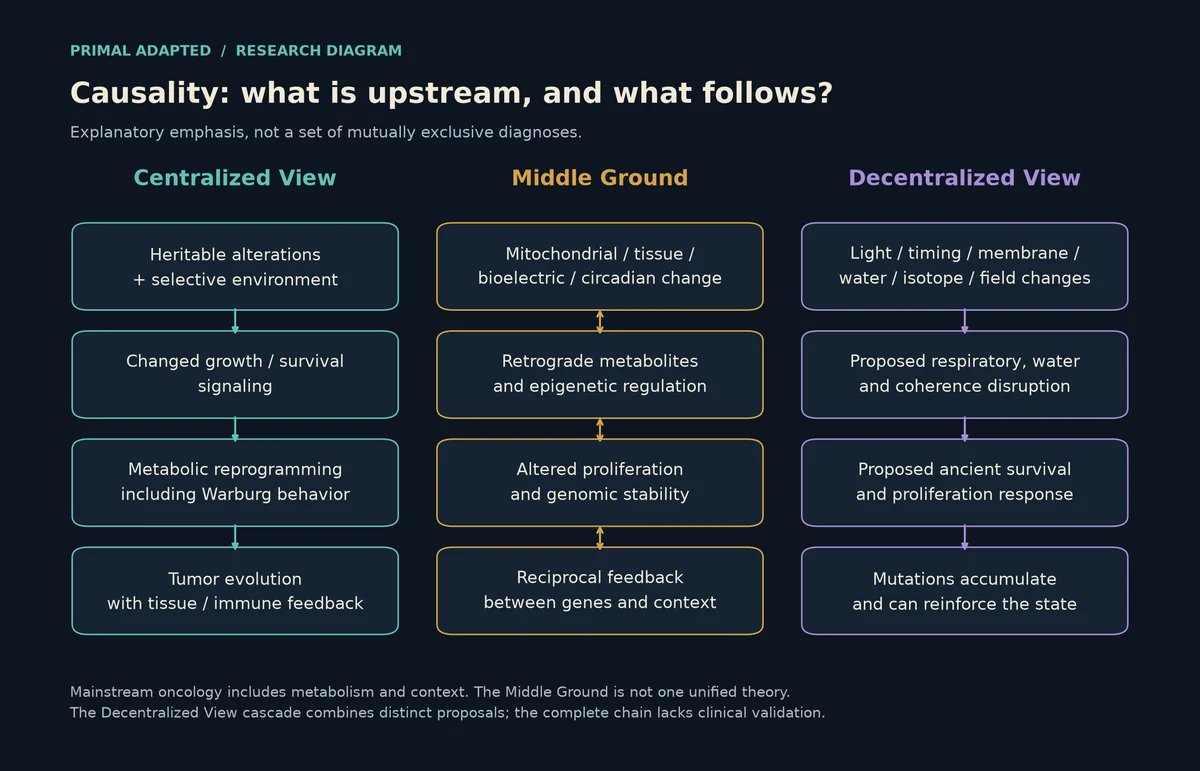
In the Decentralized View, the question changes from which growth gene was altered to which physical constraints stopped holding. Advocates connect respiratory membranes, water, light timing, isotope distribution and electrical communication into a system that maintains differentiation. Cancer is interpreted as a new stable cellular state produced when those constraints weaken together.
The account below separates the physical principle, the biological measurement and the proposed cancer-level extension. Electron tunneling is real physics. UPE is measurable. Bioelectric interventions can change model outcomes. Those facts do not automatically validate the connections proposed among them.
A mechanism also has a scale. Electron transfer can occur across angstroms, whereas a crista spans tens to hundreds of nanometers and a tumor spans millimeters or more. A causal explanation must show how a change at one scale propagates to the next. Shared words such as energy or coherence cannot replace the missing steps.
1. Electron tunneling: the respiratory chain as molecular geometry
An electron in a respiratory protein does not travel like a bead sliding down a wire. Its quantum state can couple a donor cofactor to an acceptor across a molecular barrier. Transfer depends on separation, the intervening protein, energetic driving force and rearrangement of the surroundings.
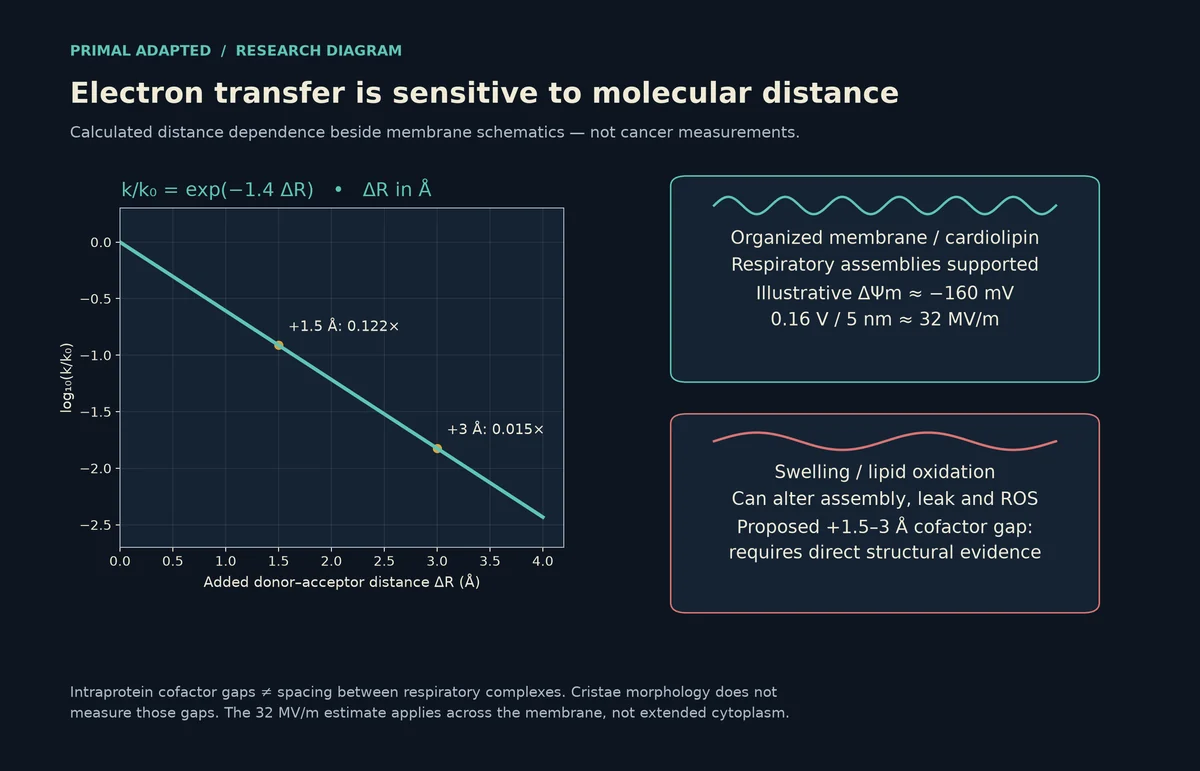
Moser, Keske, Warncke, Farid and Dutton analyzed the distance dependence of biological electron transfer [23]. A useful simplified form is k ∝ exp(−βR), with an illustrative rate-decay coefficient β around 1.4 Å⁻¹. Holding other factors fixed, increasing separation by 1 Å gives exp(−1.4), about one-quarter the rate. Two angstroms give about one-sixteenth. An extra 1.5 Å gives about one-eighth; 3 Å gives about one-sixty-seventh.
These are relative calculations, not measured cancer-cell rates. The prefactor and energetic terms matter. In Marcus-type descriptions, reorganization energy and driving force affect the activation barrier. Orientation and protein packing can matter as much as a simple distance. A rate-limiting step elsewhere may prevent a microscopic change from controlling total respiration.
Complex I transfers electrons from NADH through flavin and iron–sulfur centers toward ubiquinone. Complex II connects succinate oxidation through its flavin and iron–sulfur centers to the quinone pool. Complex III uses hemes and a Rieske iron–sulfur center in the Q cycle. Cytochrome c carries electrons to Complex IV, whose heme and copper centers support oxygen reduction. Complex II contributes electrons but does not pump protons.
There are short cofactor-to-cofactor transfers within proteins and transport by mobile carriers between proteins. Ubiquinone diffuses in the membrane; cytochrome c moves in the membrane-facing intermembrane compartment. These are not all one continuous tunneling pathway across successive gaps between separate complexes.
What cristae and cardiolipin can change
The inner mitochondrial membrane houses this machinery in folds called cristae. Cardiolipin interacts with respiratory proteins and helps support membrane organization. Oxidation, remodeling, altered curvature or disturbed assembly can change respiration, proton leak, cytochrome-c interactions and the distribution of complexes.
Kruse's broader interpretation connects membrane swelling and protein separation to impaired electron movement. The distance sensitivity makes this a physically meaningful question. But swelling a crista is not equivalent to stretching every iron–sulfur gap inside a folded protein. Demonstrating that link requires structural measurements of the relevant cofactors, not just an image of a swollen organelle. The precise source for that broader attribution remains flagged for verification.
Electron accumulation can increase ROS formation at particular sites when redox conditions favor oxygen reduction. Complex I flavin and quinone-associated chemistry and Complex III's quinone cycle are examples. ROS does not increase monotonically whenever flow slows: substrate availability, oxygen, inhibitors, reverse electron transport and membrane potential determine the outcome.
In a coupled chain, slowing oxygen reduction can leave upstream carriers more reduced. A reduced carrier can then encounter oxygen outside the intended catalytic sequence. In other conditions, inhibiting substrate entry reduces the electron supply and lowers ROS. This explains why two interventions both described as impairing respiration can produce opposite oxidative effects.
Thirty million volts per meter — across which distance?
A mitochondrial potential magnitude of roughly 140–180 mV is an illustrative physiological range, with the matrix negative. Dividing 0.16 V by 5 × 10⁻⁹ m gives 3.2 × 10⁷ V/m, or about 32 MV/m, across the membrane. A tiny voltage corresponds to a large field when the distance is tiny.
This does not mean an unscreened 32 MV/m field extends through the cytoplasm. Dielectric properties, surface charge, ionic screening and geometry constrain the field. It does not mean all cancer mitochondria are depolarized; some are strongly polarized. A tumor-specific claim requires calibrated measurements rather than voltage-sensitive dye intensity alone.
The proton-motive force is not voltage alone. It includes the chemical difference in proton activity across the membrane. ATP synthase responds to that electrochemical potential, while leak pathways dissipate part of it. Changes in ATP demand, transport and substrate supply can alter voltage without requiring permanent structural damage.
The proposed chain is membrane injury → altered electron/proton flow → redox stress → greater dependence on glycolysis. Each arrow can operate in some systems. What remains unestablished is that angstrom-scale separation caused by cristae swelling is the common first cause of human cancer.
2. Cardiolipin, DHA and the proposed light–membrane connection
Cardiolipin carries four acyl chains and a characteristic charged headgroup. Its interactions with proteins and curvature help organize the inner membrane. Respiratory supercomplexes, often called respirasomes, are assemblies of respiratory components; their stability and function can depend on lipids. Proton behavior near an interface can differ from behavior in bulk solution, making surface proton transfer a biophysical research question.
Calling cardiolipin a proton trap expresses a proposed local role in proton retention and movement. It does not mean cardiolipin alone sets the proton-motive force. That force is maintained by respiratory chemistry, transport and membrane permeability. Cardiolipin composition varies by tissue; a mouse brain-tumor lipidomic pattern is not a universal dietary target.
The membrane is also chemically vulnerable. Oxidation of susceptible lipid chains can alter packing and produce signaling or damaging molecules. Cytochrome c interacts with cardiolipin, and changes in that interaction participate in apoptotic processes. A lipid alteration can therefore affect both energy handling and the threshold for programmed cell death. The same event can have different consequences depending on dose, location and cellular state.
DHA belongs to a different membrane story. It is a 22-carbon fatty acid with six cis double bonds, prominent in retinal and neural membranes. Crawford and colleagues' 2013 paper proposes that its conservation reflects a quantum-electronic role in precise neural signaling [24]. Their argument moves from conserved structure to electronic function rather than treating DHA only as a flexible membrane constituent.
Each double bond contains π electrons. The double bonds are methylene-interrupted, however, so DHA is not a conventional continuously conjugated carbon chain. Its six π bonds cannot simply be described as one uninterrupted delocalized wire. Crawford's model proposes special conditions under which electronic transfer or communication could involve this arrangement. The proposed behavior is distinct from the established chemistry of DHA's structure.
Kruse extends light–lipid arguments into mitochondrial and cancer discussions. The publicly accessible portion of his brain-cancer post links blue-light exposure, swelling and deuterium entry, and assigns red light a countervailing regenerative role [43]. This is his interpretation. The accessible text is not a controlled measurement of isotope movement in a tumor; members-only material was not treated as verified content.
Absorbing light is a specific molecular event
Mitochondrial and cellular chromophores have measurable electronic transitions. Heme and porphyrin systems absorb in Soret and visible bands. NADH and aromatic amino acids interact with ultraviolet light. Cytochrome-c oxidase contains heme–copper centers whose red and near-infrared absorption has been discussed in photobiomodulation models [25]. Contributions depend on oxidation state and wavelength; 600–1000 nm is not a uniform absorption band shared by every copper center.
In photobiomodulation research, proposed routes include changes in redox state, nitric-oxide interactions, ROS signaling and ion regulation. Wavelength, irradiance, duration and tissue penetration matter. A photon absorbed in skin is not automatically delivered to a deep tumor or mitochondrial matrix. Ordinary molecular absorption does not establish a coherent optical communication system.
The Decentralized View joins these pieces into a membrane-based energy-and-information model: environmental light influences timing and chromophores, lipids organize interfaces, and mitochondria translate those conditions into electrical and chemical state. Its cancer-specific extension requires evidence that proposed DHA electronic behavior changes tumor initiation or progression independently of ordinary lipid, receptor and oxidative mechanisms. That link has not been clinically validated.
3. Water, ions and what the first tumor-NMR measurements showed
Water in a cell is not all equivalent. Molecules next to proteins, membranes and ions can have altered rotational dynamics and exchange behavior. Surfaces, crowding and compartment boundaries affect measurements. This interfacial heterogeneity is accepted without requiring a single new bulk phase of intracellular water.
Gilbert Ling's Association-Induction Hypothesis makes a larger claim [26]. In his model, extended protein backbones organize multilayer water, and ATP binding changes the electronic state of protein adsorption sites. That change alters water polarization and relative potassium and sodium association. ATP is cast as an inducer of a cooperative physical state, not only as fuel hydrolyzed by pumps.
Ling argued that selective ion association could account for high intracellular K⁺ and low Na⁺, and challenged energy accounting in pump-centered models. The conventional account includes directly measured Na⁺/K⁺-ATPase transport, selective channels, fixed intracellular anions, osmotic balance and metabolic support. His energy-budget objection is not an established demonstration that the sodium–potassium pump is impossible or unnecessary.
The distinction is experimentally testable. Can ion distributions persist when transport is independently measured or blocked? How much water has altered dynamics, over what distance and for how long? Does ATP act through binding, hydrolysis or both in a preparation? A potassium change cannot answer all these questions by itself.
A further distinction is between concentration and activity. An ion associated with a macromolecule need not behave like the same ion freely dissolved in water. Measurements that infer total intracellular potassium are not necessarily measurements of its freely exchangeable activity. Both transport-centered and association-centered accounts need to specify which quantity their experiment actually observes.
Damadian's 1971 finding — contrast, not a water-phase detector
Raymond Damadian's 1971 Science paper measured nuclear magnetic resonance relaxation differences between malignant and normal rat tissues [27]. Tumor samples showed prolonged water-proton relaxation times. T₁ describes recovery of longitudinal nuclear magnetization; T₂ describes decay of transverse coherence. Neither is a direct stopwatch for cellular ATP production.
Ling and Damadian interpreted relaxation behavior in relation to the physical state of cellular water. The broader idea was that malignant tissue has less restricted or differently organized water. But relaxation depends on water content, molecular motion, exchange, macromolecules, paramagnetic species, field strength and measurement conditions. Longer T₁ or T₂ is not a unique signature of lost multilayer water or an exclusion zone.
The work contributed to recognition of tissue NMR contrast. Clinical MRI additionally required spatial encoding and image reconstruction, with contributions from Paul Lauterbur, Peter Mansfield and others. Describing one tumor-relaxation measurement as the whole invention of MRI would merge contrast discovery with the separate problem of making spatial images. Original priority documents for that history remain listed for verification.
Even the direction of relaxation change needs context. Restricted motion does not make every relaxation time shorter at every frequency. Clinical tumors have diverse appearances, and inflammation, edema and normal tissues can overlap. MRI is not a direct assay for a universal ordered-water-to-cancer transition.
Pollack's exclusion zones and the proposed mitochondrial water layer
Chai, Yoo and Pollack reported that radiant energy could enlarge particle-excluding regions near hydrophilic surfaces [28]. Pollack's larger model describes negatively charged, ordered water with a proposed H₃O₂⁻ composition, separated from a proton-rich region. Infrared input is proposed to support charge separation and zone growth.
Particle exclusion is observable. Identifying it with a distinct hexagonal-sheet phase is an interpretation. Surface chemistry, proton gradients and diffusiophoresis can also move particles away from interfaces. A bead-free zone is not, by itself, molecular structure determination. Ling's adsorbed multilayers and Pollack's macroscopic exclusion zones are related in some writers' accounts but are not identical models.
In the Decentralized View, mitochondrial metabolic water and energy release sustain an ordered perimitochondrial environment. Its loss is proposed to increase bulk-like water, swelling and ion redistribution, depolarize the plasma membrane and alter chromatin. Each change has conventional routes too: transporter activity, osmotic stress, ATP depletion, calcium signaling and cytoskeletal tension produce overlapping effects.
A full test would measure water structure, local field, ion activity, volume, Vmem and chromatin simultaneously while changing one variable independently. It would need to show that water change precedes and mediates proliferation. No verified clinical study here establishes that sequence. The membrane-field calculation cannot substitute for measuring an extended ordered-water zone outside mitochondria.
4. Deuterium: isotope physics, DNA tunneling and the ATP nanomotor
Hydrogen's common isotope, protium, has one proton in its nucleus. Deuterium has a proton and neutron. The extra mass changes molecular vibration, zero-point energy and reaction kinetics without changing the atom's basic chemical identity. Natural water contains deuterium at roughly the hundred-parts-per-million scale, with geographical and dietary variation.
For a harmonic bond, vibrational frequency varies approximately as the inverse square root of reduced mass. A heavier isotope generally lowers zero-point vibrational energy. In a simple barrier picture, tunneling probability depends exponentially on the square root of mass and on barrier width. A deuteron can tunnel much less readily than a proton under otherwise equivalent conditions.
A kinetic isotope effect compares rates for isotopically substituted reactions. Its size depends on which bond moves in the rate-limiting step, the barrier, temperature and coupling to other motions. A large effect under highly substituted laboratory conditions does not establish a large effect from small changes around natural abundance. Concentration, localization and exchange are essential parts of the argument.
The tunneling relation can be expressed schematically as P ∝ exp[−2a√(2m(V−E))/ℏ]. Here a is barrier width, m is particle mass and V−E is the barrier energy above the particle's energy. This simplified expression illustrates mass sensitivity; it is not a calculation of a proton's actual passage through ATP synthase or hydrated DNA. Real molecular barriers fluctuate and involve coupled coordinates.
Löwdin's DNA proposal
Löwdin's 1963 paper considered proton tunneling in DNA and its biological implications [29]. Proton transfer along hydrogen bonds can produce rare tautomeric arrangements of bases. If an altered arrangement persists during copying, a base may pair differently. The proposal gives a quantum-mechanical route to a copying error rather than treating mutation as an event without physical chemistry.
Several stages must align: formation of the altered state, survival until polymerase encounters it, incorporation, escape from proofreading and failure of repair. Showing tunneling is possible is not the same as determining its contribution to the human cancer mutation burden. Solvation, base stacking, enzyme active sites and temperature modify the landscape.
Deuterium can alter those dynamics, but the sign of a mutation effect cannot be inferred from mass alone. Slowing transfer could suppress formation of one rare state while prolonging another. The claim that more deuterium necessarily increases cancer-driving tautomeric mutations is not established by Löwdin's theory.
Somlyai and Boros: isotope distribution as a growth signal
Somlyai and colleagues reported reduced cell growth under deuterium-depleted conditions in 1993 [30]. Their program interprets D/H balance as a regulatory variable. In this model, preferential removal of light hydrogen through proton-transport systems could raise intracellular D/H during growth signaling, while metabolic processes oppose that increase.
Boros and colleagues' 2016 paper connects isotope exchange in the TCA cycle with cell transformation [31]. Their proposal focuses on submolecular isotope routing: which substrates carry hydrogen, where exchange occurs, and how biosynthesis and mitochondrial water production alter local isotopic composition. The paper presents a mechanistic model, not a completed human efficacy trial.
The Na⁺/H⁺ exchanger component proposes that isotope selectivity could couple alkalinization to a D/H-related cell-cycle signal. Measuring transporter selectivity, compartment concentrations and downstream effects is necessary to establish that route. A bulk drinking-water isotope value does not reveal D/H at an individual mitochondrial proton channel.
A metabolite can also acquire its hydrogen atoms from more than one source. Carbon and hydrogen do not necessarily follow the same route through intermediary metabolism. Hydrogen can exchange with water at one step and remain bound at another. Boros's emphasis on molecular position is intended to distinguish that routing from a single whole-body isotope average. Establishing it requires position-sensitive measurements and explicit isotope balances.
The ATP-synthase rotor — and what would count as stalling
F₀F₁ ATP synthase converts proton-motive force into rotation and catalytic changes. Protons enter and leave the membrane sector through access pathways; protonation states couple movement of the c-ring to the central stalk. The catalytic head changes conformation to synthesize ATP. Rotation rates can correspond to thousands of revolutions per minute in appropriate preparations, but vary with species, load and proton-motive force.
In the Decentralized View, heavier hydrogen is proposed to interfere with efficient proton transfer and rotation. The image of a stuttering nanomotor makes the mechanism tangible. It has not been demonstrated that small natural-abundance D/H differences claimed in human cancer patients cause a characteristic, directly measured rotor-stalling defect.
Isotope effects can occur without literal mechanical jams. Transfer involves hydration networks and hydrogen-bond rearrangement; the relevant quantity may be a rate change or coupling efficiency rather than one deuteron blocking a hole. High concentrations of heavy water alter many proteins and cytoskeletal processes, so such experiments do not isolate ATP synthase as the sole target.
Claims that burning fat reliably produces sufficiently deuterium-depleted matrix water need isotope mass balance. Food source, biosynthetic history, exchange with body water and compartment turnover matter. Cytochrome-c oxidase makes water by reducing oxygen using electrons and protons; red light does not remove neutrons from deuterium. Any isotopic-composition change requires selective routing or fractionation, not nuclear conversion.
The human evidence and its limits
Kovács and colleagues reported a randomized Phase II prostate-cancer study with 44 participants, 22 assigned to deuterium-depleted water and 22 to comparison water, alongside conventional treatment [32]. The report describes differences in response-related measures and follow-up outcomes. It also includes retrospective observations, a different form of evidence that cannot be combined with the randomized portion as though it were one large controlled trial.
The trial was small, conventional treatments were not standardized into one uniform regimen, and multiple outcomes were assessed. It cannot establish a broadly effective treatment across cancer types. Reported benefits require independent, larger confirmation with prespecified endpoints, transparent allocation and analysis, and meaningful survival and quality-of-life outcomes.
Published cell and animal findings justify biological questions about isotopes. They do not supply the missing large, independently replicated randomized Phase III evidence. Deuterium depletion is not established standard oncology care. This article gives no water concentration, dosing plan or dietary treatment protocol.
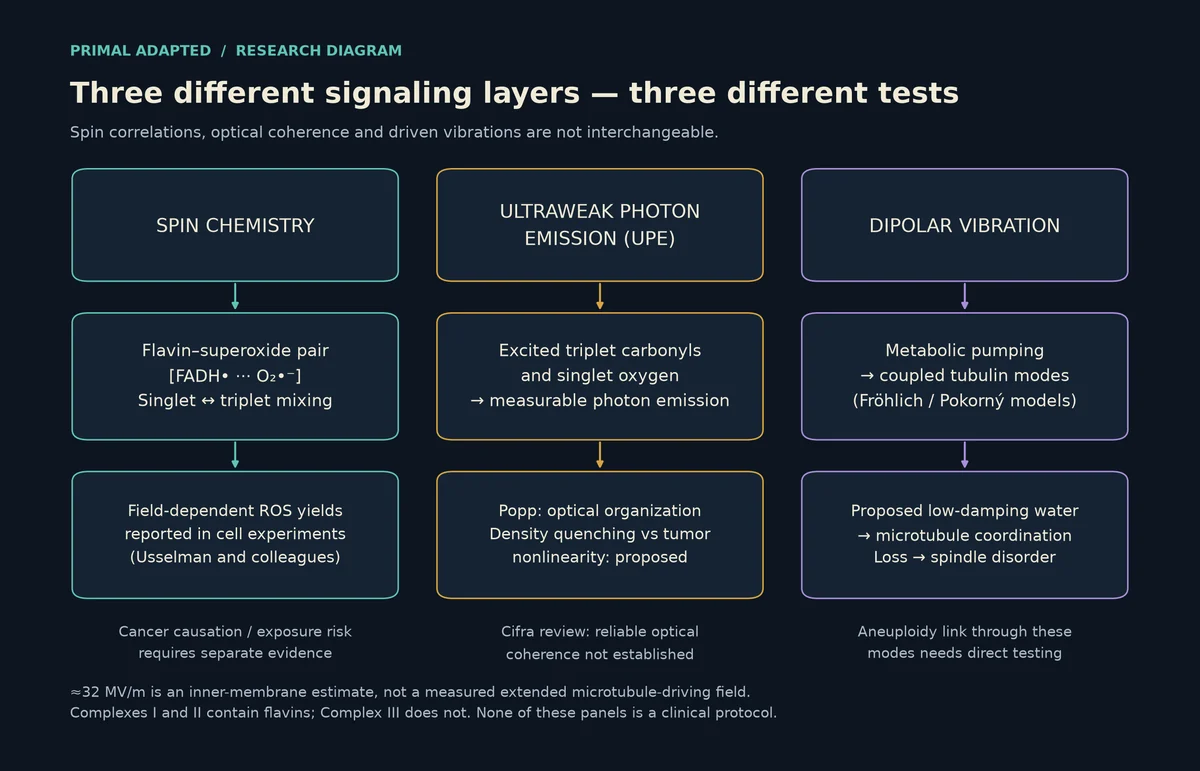
5. Ultraweak Photon Emission (UPE): oxidative chemistry or optical organization?
Living material emits extremely faint light without an external illumination pulse. Cifra and Pospíšil describe the mechanisms and measurement of Ultraweak Photon Emission (UPE) [33]. During oxidative reactions, electronically excited molecules form and release photons when they relax. Photomultipliers and sensitive cameras detect the signal under controlled dark conditions.
Lipid oxidation provides a route through high-energy intermediates to excited triplet carbonyls, represented as ³R=O*. Singlet oxygen can contribute near-infrared emission around 1270 nm; paired-molecule transitions can contribute in red spectral regions. Energy transfer to other chromophores changes the spectrum. UPE is not one universal wavelength or one dedicated light-producing organelle.
Malignant cells can alter ROS production, antioxidant capacity, lipids, oxygen use and cell death. Any of these changes photon output. Increased emission can therefore measure oxidative state without demonstrating communication. Measurable emission does not rule out signaling; signaling requires evidence that a receiver detects it and changes behavior under controlled conditions.
Gurwitsch's historical mitogenetic-ray work proposed ultraviolet mediation of growth effects between biological preparations. Original preparations, dates and replication records were not checked against original documents here. The modern existence of UPE does not retrospectively validate every reported growth-transfer effect.
Popp's model: the cell as an optical collective
Popp and colleagues proposed that biological organization involves a coherent photon field, with DNA and other structures storing or exchanging excitation [34]. Roeland van Wijk's research extended photon measurement and analysis. In this approach, temporal patterns and density dependence are interpreted as possible collective regulation rather than simply independent chemical flashes.
One proposed cancer distinction is that healthy-cell emission becomes quenched as density and collective regulation increase, while malignant-cell emission follows a different nonlinear relationship. The Decentralized View connects that contrast with loss of contact inhibition and an optical organizing field. Exact universal density curves and their independent replication were not verified here; they are model claims, not diagnostic facts.
Contact inhibition has biochemical and mechanical routes, including adhesion, polarity and growth-control signaling. Establishing an optical contribution requires separating density-dependent emission from oxygen depletion, nutrients, reabsorption, death, detector geometry and cell size. Correlation between output and proliferation cannot identify which direction causation runs.
In the proposed communication model, a photon must reach an absorber with an appropriate transition and produce a response distinguishable from background excitation. If many photons are reabsorbed locally, external brightness need not equal internal flux. But an unmeasured internal flux cannot be assumed large enough to organize a tissue. Absorption cross-sections, propagation losses, competing chemistry and receiver gain all enter the calculation.
Coherent, Poissonian and nonclassical are not synonyms
A coherent optical field has defined correlation properties. An ideal coherent state has Poisson photon-number statistics: variance equals mean. Sub-Poissonian counts have variance below the mean and can indicate nonclassical behavior under properly controlled measurement. Calling a signal both coherent and sub-Poissonian without specifying the state and measurement confuses distinct concepts.
Many independent weak emitters also yield approximately Poisson counts. Detector dead time can artificially suppress variance; noise, drift and afterpulsing distort it. Delayed luminescence after illumination differs from spontaneous UPE. A long decay curve is not itself a measurement of optical phase coherence.
Cifra, Brouder, Nerudová and Kučera's 2015 review concluded that UPE was experimentally established but reliable coherence or nonclassicality evidence had not been achieved in the literature examined [35]. That is an evidence-quality assessment, not denial of cellular light emission. This draft does not claim an exhaustive update overturning or reconfirming every later optical study.
A decisive experiment would measure calibrated spectra, photon correlations, coherence time and length, and biological reception in matched normal and malignant systems. It would manipulate the proposed optical interaction without merely changing oxidation. No verified study here establishes lost optical coherence as a clinical cause or universal marker of cancer.
6. Spin chemistry: weak fields without a large heating effect
Molecular oxygen has a triplet ground state, written ³Σg⁻, with total electronic spin S = 1. Many stable organic molecules are closed-shell singlets, S = 0. Spin restrictions help explain why oxygen does not instantly oxidize every compatible molecule. Enzymes, metals and radical pathways make biologically useful oxygen chemistry possible.
A radical has an unpaired electron. When two radicals form together, their spins can begin in a correlated state. Singlet–triplet mixing changes the probability of recombination or escape along different channels. Hyperfine interactions couple electron spins with nuclear spins. Magnetic fields alter spin evolution through Zeeman interactions.
A representative proposed pair is [FADH• … O₂•⁻], involving flavin semiquinone and superoxide. Complexes I and II contain flavins; Complex III does not contain a flavin cofactor, although it participates in quinone and radical chemistry. Assigning the identical flavin pair to every respiratory complex would be chemically incorrect.
Cryptochromes provide another radical-pair setting, especially in light-dependent animal magnetoreception. A mechanism demonstrated or modeled in cryptochrome is not automatically the mechanism in a respiratory enzyme. Radical lifetimes, spin relaxation, confinement and local chemistry differ. Superoxide's spin relaxation constrains proposed long-lived pairs.
Why the thermal-energy comparison is not the whole argument
At weak fields, electron Zeeman energy can be far below kBT. That makes bulk thermal alignment tiny, but radical-pair chemistry does not require a field to overpower all thermal motion. The field changes the evolution of a short-lived spin-correlated reaction before products are selected. A small yield change can, in principle, feed into biochemical amplification.
This does not imply an effect from any field of any frequency. Pair lifetime, hyperfine couplings, orientation and frequency determine whether a perturbation matters. A radio-frequency experiment at one resonance cannot be generalized to all wireless exposure, static fields or cancer types.
Usselman, Hill, Singel and Martino reported altered ROS measurements in rat pulmonary arterial smooth-muscle cells under a 7 MHz, 10 μT RMS field combined with a static 45 μT field [36]. The author's name is David Singel. The paper proposed radical-pair modulation while acknowledging that indirect ROS measurements could not exclude other mechanisms.
Usselman and colleagues' 2016 work connected field-dependent ROS partitioning with respiration and glycolysis changes [37]. H₂O₂ acts as a signaling molecule; superoxide, dismutation, antioxidant enzymes and localization complicate any simple product ratio. The work supports controlled investigation of spin-dependent bioenergetics, not a claim that non-native fields have been shown to cause human cancer through this route.
A direct cancer-cell experiment by Castello, Hill, Sivo, Portelli, Barnes, Usselman and Martino reported increased hydrogen-peroxide production and reduced proliferation in HT1080 fibrosarcoma cultures under particular radio-frequency conditions [44]. Those endpoints establish an exposure-associated laboratory response in that preparation; they do not independently identify the radical pair responsible.
Other Barnes–Greenebaum field–radical claims beyond this study were not directly checked here. Laboratory growth effects are not established exposure-risk estimates or treatments. Replication requires dosimetry, sham exposure, temperature control, blinding and chemically specific ROS measurements.
Becker's injury currents belong to a different electrical scale
Robert O. Becker investigated bioelectric factors in amphibian limb regeneration [38]. His program connected injury-associated DC potentials with repair, differentiation and regenerative capacity. That work concerns ionic currents and tissue organization, not automatically quantum spin coherence.
The Decentralized View draws a parallel: an electrical environment can participate in whether cells retain or change identity. The parallel is conceptual unless pathways are experimentally linked. Exact human cancer-reversal claims from Becker's books were not verified and are not asserted. Regeneration studies do not establish that grounding or arbitrary current application can redifferentiate a human tumor.
7. Fröhlich, Pokorný and the proposed vibrating cell
A protein can carry an electric dipole because positive and negative charges are distributed unevenly. If it vibrates, its dipole can oscillate. Microtubules contain α/β-tubulin dimers and participate in transport, organization and the mitotic spindle. Their mechanical and electrostatic properties motivate physical models of cellular coordination.
Fröhlich's 1968 proposal concerned energy storage and long-range coherence in driven biological systems [39]. Coupled oscillators supplied with energy and connected to a thermal bath might concentrate energy in a mode above a pumping threshold through nonlinear interactions. Often-discussed scales include roughly 10¹¹–10¹² Hz in some models; there is no single measured universal cellular frequency.
The Bose-like analogy concerns occupation of modes in a nonequilibrium system. It does not mean a warm cell becomes an ordinary ultracold atomic Bose–Einstein condensate. Whether occupation is phase-coherent, how long coherence persists and whether it performs a biological function are separate questions.
A pumped system must satisfy an energy budget. Energy supplied to a mode must compete with dissipation into its surroundings. Increasing population in one mode does not establish a long-range force strong enough to control an organelle. The coupling between oscillator and target, the quality factor and the relevant timescale must be specified to turn a vibration model into a cellular mechanism.
Pokorný's proposed mitochondria–water–microtubule circuit
Pokorný's 2012 model places mitochondria at the boundary between metabolism and collective cellular physics [40]. Mitochondria provide energy and are proposed to sustain surrounding electrical and water conditions that reduce damping of microtubule oscillations. Tubulin dipoles could support a coherent electrodynamic contribution to organization and communication.
In his model, respiratory dysfunction weakens the ordered-water state and changes damping. Energy that would support collective oscillation dissipates differently. Altered oscillations are proposed to disturb transport and intercellular coordination, contributing to malignant behavior and invasion.
The proposed sequence is respiration → electrical/water organization → microtubule vibration → tissue order. Each term is measurable in principle. But a large transmembrane field is not evidence of that field persisting over a thick cytosolic shell. Electrolytes screen static fields; geometry, charge distribution, screening length and energy flow require quantitative accounting.
The respiratory chain pumps protons from the matrix into the intermembrane compartment, not directly into unlimited surrounding cytoplasm. Outer-membrane permeability and local proton dynamics must be included before assigning an external field to proton pumping. These boundary conditions matter when moving from a membrane capacitor to a cell-wide organizer.
Can spindle errors be physical before they are genetic?
Segregating chromosomes requires microtubule assembly, kinetochore attachment, motors and checkpoints. Mechanical disturbances, altered tubulin dynamics and energy stress can cause errors. Aneuploidy then changes gene dosage and selection pressures. Physical disruption and genetic instability can form feedback without requiring the proposed coherent field.
Pokorný's extension proposes altered collective oscillation upstream of spindle failure. Establishing that route requires measuring the oscillation in dividing cells, showing that change precedes errors, and restoring segregation by correcting the oscillation while controlling ordinary microtubule chemistry and ATP supply.
Similarly, adhesion loss, matrix remodeling and cytoskeletal changes are measurable. An electrodynamic contribution to invasion must be separated from those processes. Clinical use of applied electrical fields in oncology does not itself validate Fröhlich coherence or Pokorný's endogenous-field model: different physical interventions can act through different mechanisms.
This is a mechanistic research proposal, not a completed replacement for molecular oncology. Its testable variables include mode occupation, damping, coherence length, local fields and force coupling. The paper does not establish all of them throughout a living human tumor.
8. The atavistic model: an old survival toolkit in a new environment
Davies and Lineweaver's 2011 atavistic model describes cancer through multicellularity's evolutionary history [41]. A cell already possesses ancient capacities for replication, metabolism and stress response. Multicellular organization restrains and coordinates them. When higher-level control fails, older programs may become more influential.
Their Metazoa 1.0 framing does not require literal transformation into a free-living ancestral organism. It proposes that progression follows constraints inherited from older biological architectures. The theory seeks recurring behavioral patterns rather than an unlimited collection of arbitrary accidents.
The Decentralized View combines that framing with the physical layers above. Disrupted light timing alters endocrine and clock signals. Tissue injury changes oxygen delivery and matrix constraints. Mitochondrial and lipid changes shift electron flow, redox balance and metabolites. Ion redistribution changes Vmem. Advocates additionally propose that water, isotope handling and collective optical or vibrational organization help determine whether differentiation persists.
In this synthesis, proliferation is interpreted as survival when multicellular regulation becomes difficult to maintain. Mutations can accumulate through oxidative damage, replication stress, impaired repair and segregation errors. NAD⁺-dependent PARP and sirtuin activity links metabolism with stress responses, but NAD⁺ consumption is not equivalent to every repair pathway failing.
An atavistic explanation also differs from simple clonal selection. Selection describes which variants reproduce under current conditions. Atavism additionally proposes that the available behaviors are structured by older regulatory architectures. A discriminating prediction would identify an ancestral dependency before measuring it, then show that the dependency recurs across otherwise dissimilar tumors.
What the synthesis does not establish
Cancer cells do not universally lack oxygen, lose mitochondrial voltage or depend exclusively on fermentation. They can use oxygen and oxidative phosphorylation aggressively. Ancestral unicellular life was metabolically diverse; fermentation is not one single program shared by every ancient lineage. A survival-program account still needs identifiable circuitry and activation conditions.
Wallace's mitochondrial genetics, Seyfried's respiratory account, Levin's bioelectric work, Pollack's water model, Pokorný's electrodynamics and Kruse's environmental synthesis are not interchangeable. Connecting them is an interpretive construction. The verified sources do not jointly demonstrate one pathway from sunlight deprivation through matrix deuterium and optical decoherence to every cancer.
For genetic oncologists, a downstream-only role for mutations conflicts with direct genetic causality in particular cancers. For metabolic researchers, active respiration is often essential for tumor growth. For biophysicists, extended fields and coherent modes require measurement under physiological ionic and thermal conditions. For clinical researchers, plausible mechanisms cannot replace patient outcomes.
Those objections specify tests rather than erase questions. A synthesis needs temporal ordering, selective perturbation and rescue across several models, followed by independent replication. Clinical application additionally needs controlled benefit-and-harm evidence. The complete causal synthesis and its proposed environmental treatment implications have not met that standard in the sources verified here.
The Three Views Side by Side
The Centralized View explains cancer through heritable changes, selection and interaction with a tumor ecosystem. Metabolism, matrix and immune context are part of that account. Direct causal demonstrations connect molecular alterations with reproducible behavior and, in selected diseases, effective targeted treatment.
The Middle Ground asks how much causal control resides in mitochondria, architecture, voltage and timing. Experiments show that the same nuclear background can express different behavior under different conditions. Those results challenge a description of DNA as an autonomous script, while leaving room for genetic contributions and bidirectional causality.
The Decentralized View centers the physical state: transfer geometry, lipid interfaces, water, isotopes, spin chemistry and collective electromagnetic organization. Some principles are established; several biological links are model-specific; the complete chain remains unvalidated. No label changes an individual claim's evidentiary status.
At-a-Glance Comparison Table
| Question | Centralized View | Middle Ground | Decentralized View |
|---|---|---|---|
| Main mechanism | Heritable alterations, selection and tumor-ecosystem interactions | Reciprocal metabolic, tissue, epigenetic and electrical regulation | Proposed loss of physical conditions supporting multicellular coordination |
| Primary trigger | Context-specific genetic and environmental damage; no universal trigger | Respiratory, tissue, endocrine or electrical disturbance can contribute | Light/timing, water, isotope, membrane and field disturbances proposed upstream |
| Mutations | Causal drivers in many cancers; passengers and context also matter | Both causes and consequences in feedback | Often interpreted as downstream, with later reinforcement |
| Warburg shift | Growth-associated reprogramming; can coexist with respiration | Injury, adaptation or signaling, depending on model | Often framed as fallback after respiratory/physical-state disruption |
| Water, light, fields | Water biophysics and circadian signaling accepted; claims tested separately | NMR, voltage, matrix and timing are accessible variables | Extended ordered water and optical/vibrational coordination proposed |
| Researchers | Hanahan, Weinberg, Vogelstein, Vander Heiden, DeBerardinis, Chandel | Wallace, Seyfried, Soto, Sonnenschein, Bissell, Levin, Blask | Ling, Pollack, Popp, Crawford, Somlyai, Boros, Pokorný, Kruse; Davies/Lineweaver provide an evolutionary model |
| Evidence | Extensive mechanistic and clinical evidence, varying by cancer | Strong mechanisms plus model-specific findings; no single clinical theory | Accepted physics, cell/animal findings and theoretical extensions; no validated unified treatment model |
The unanswered question is about ordering
All three views can describe a cell with altered genes, high lactate output, changed water relaxation, abnormal voltage and oxidative stress. Finding those features together does not reveal which came first. Discriminating experiments change one variable, establish timing and ask whether the later changes still occur.
For tunneling, that means measuring cofactor geometry and transfer kinetics. For water, it means distinguishing structure from particle movement and relaxation proxies. For deuterium, it means measuring compartment-specific distributions and enzyme effects at relevant concentrations. For UPE, it means correlations and reception rather than brightness alone. For collective vibrations, it means measuring modes and demonstrating functional rescue.
A rescue experiment is especially informative when it is selective. If correcting an ion conductance prevents a tumor-like outcome while the oncogene remains expressed, voltage-dependent signaling has causal leverage in that model. If restoring a mitochondrial component changes chromatin and growth, the organelle contributes causally. Neither result identifies every intervening pathway or proves the same leverage in a patient.
The distinction between prevention, suppression and reversal also matters. Preventing a tumor-like structure from appearing in an embryo is not the same outcome as reducing growth of an implanted tumor. Reducing a cultured cell's proliferation is not equivalent to preventing metastasis. Killing cells is not equivalent to restoring differentiated tissue. Each endpoint answers a different question.
Researchers also distinguish a tumor-cell effect from an organism-level benefit. A perturbation can inhibit a cancer culture while harming immune cells or normal tissues. An intervention may change a molecular marker without improving survival. The clinical test must therefore measure benefit and harm in the whole patient, not infer success from an isolated biochemical change.
The deepest question is not whether cancer contains quantum physics. Every cell's chemistry does. It is which quantum and biophysical processes exert causal control over malignant behavior, at what scale, in which tumors, and with what consequences for patients. The models differ in their answers; measurements determine which connections can be retained.
Not yet verified
This section separates missing source verification from claims whose sources are verified but whose biological or clinical interpretation remains unestablished.
- Original history: Boveri's monograph, Warburg's original 1920s report, Gurwitsch's original mitogenetic-ray reports and original MRI priority documents were not directly inspected. No exact quotation, exclusive invention credit or detailed original protocol is assigned to them.
- Older transfer studies: original Israel–Schaeffer, Howell–Sager and Koura papers were not directly checked. Their discussion in Seyfried's synthesis does not establish universal four-cross outcomes. The modern studies support only their model-specific results.
- Additional details: exact optogenetic cancer-normalization protocols, a particular near-zero-coding-driver tumor cohort, other Barnes–Greenebaum experiments beyond the Castello study and Kruse's precise broader cristae-distance attribution need direct verification. No numerical or clinical conclusion rests on them.
- Water: intracellular H₃O₂⁻ sheets, a thick infrared-built mitochondrial exclusion zone and a causal chain through swelling, ion loss and chromatin change are not established in human cancer. NMR relaxation is not a unique water-phase measurement. Ling's multilayers and Pollack's zones are different models.
- Geometry and fields: no verified study here measures cristae swelling causing a 1.5–3 Å increase in intraprotein redox-center distance in cancer. Approximately 32 MV/m is a membrane-scale calculation, not a measured extended cytoplasmic field.
- DHA/light: a continuous conjugated DHA wire, universal 600-million-year molecular uniqueness and cancer reversal through DHA photon-to-current conversion were not established. Crawford's verified paper presents a neural-signaling theory, not a cancer trial. Only Kruse's accessible text was checked.
- Isotopes: universally depleted matrix water from fat oxidation, red-light-driven isotope depletion, natural-abundance ATP-synthase stalling and a transporter D/H growth switch lack direct cancer-level confirmation here. Löwdin's model does not establish a human cancer effect's sign or magnitude.
- Optical organization: exact normal-versus-malignant density curves, independent replication, universal healthy-tissue sub-Poissonian counts and DNA optical communication were not verified. The 2015 coherence review is verified; no exhaustive later-literature update is claimed.
- Vibrations and synthesis: the mitochondrial water-field–microtubule pathway to spindle errors and invasion is not established as a general human cancer mechanism. The connected synthesis is not a shared declaration by all named researchers.
- Clinical boundary: no large independently replicated randomized Phase III efficacy trial of deuterium depletion was verified. No clinical efficacy is inferred for structured water, grounding, arbitrary magnetic exposure or self-directed red/near-infrared treatment. No book-based human cancer-reversal claim is included.
Key sources
The 42 journal records below were checked online against Crossref metadata. Longer author lists are abbreviated; full returned records are retained in the verification file. Identifiers are pages or article numbers. Two descriptive source labels are explicitly marked where literal titles conflict with this site's UPE terminology. Metadata verification confirms bibliographic identity, not every interpretation or clinical conclusion. All other researcher statements are paraphrases except the single primary-text quotation from Kaipparettu and colleagues.
-
Hanahan, D.; Weinberg, R. A. (2000). The Hallmarks of Cancer. Cell 100, 57-70. https://doi.org/10.1016/s0092-8674(00)81683-9
-
Hanahan, D.; Weinberg, R. A. (2011). Hallmarks of Cancer: The Next Generation. Cell 144, 646-674. https://doi.org/10.1016/j.cell.2011.02.013
-
Hanahan, D. (2022). Hallmarks of Cancer: New Dimensions. Cancer Discovery 12, 31-46. https://doi.org/10.1158/2159-8290.cd-21-1059
-
Fearon, E. R.; Vogelstein, B. (1990). A genetic model for colorectal tumorigenesis. Cell 61, 759-767. https://doi.org/10.1016/0092-8674(90)90186-i
-
Warburg, O. (1956). On the Origin of Cancer Cells. Science 123, 309-314. https://doi.org/10.1126/science.123.3191.309
-
Vander Heiden, M. G.; Cantley, L. C.; Thompson, C. B. (2009). Understanding the Warburg Effect: The Metabolic Requirements of Cell Proliferation. Science 324, 1029-1033. https://doi.org/10.1126/science.1160809
-
DeBerardinis, R. J.; Chandel, N. S. (2016). Fundamentals of cancer metabolism. Science Advances 2, e1600200. https://doi.org/10.1126/sciadv.1600200
-
Martincorena, I.; Roshan, A.; Gerstung, M.; Ellis, P.; Van Loo, P.; McLaren, S. et al. (2015). High burden and pervasive positive selection of somatic mutations in normal human skin. Science 348, 880-886. https://doi.org/10.1126/science.aaa6806
-
Martincorena, I.; Fowler, J. C.; Wabik, A.; Lawson, A. R. J.; Abascal, F.; Hall, M. W. J. et al. (2018). Somatic mutant clones colonize the human esophagus with age. Science 362, 911-917. https://doi.org/10.1126/science.aau3879
-
Seyfried, T. N. (2015). Cancer as a mitochondrial metabolic disease. Frontiers in Cell and Developmental Biology 3, 43. https://doi.org/10.3389/fcell.2015.00043
-
Kiebish, M. A.; Han, X.; Cheng, H.; Chuang, J. H.; Seyfried, T. N. (2008). Cardiolipin and electron transport chain abnormalities in mouse brain tumor mitochondria: lipidomic evidence supporting the Warburg theory of cancer. Journal of Lipid Research 49, 2545-2556. https://doi.org/10.1194/jlr.m800319-jlr200
-
Kaipparettu, B. A.; Ma, Y.; Park, J. H.; Lee, T. L.; Zhang, Y.; Yotnda, P. et al. (2013). Crosstalk from Non-Cancerous Mitochondria Can Inhibit Tumor Properties of Metastatic Cells by Suppressing Oncogenic Pathways. PLoS ONE 8, e61747. https://doi.org/10.1371/journal.pone.0061747
-
Kaipparettu, B. A.; Ma, Y.; Park, J. H.; Lee, T. L.; Zhang, Y.; Yotnda, P. et al. (2019). Correction: Crosstalk from Non-Cancerous Mitochondria Can Inhibit Tumor Properties of Metastatic Cells by Suppressing Oncogenic Pathways. PLOS ONE 14, e0221671. https://doi.org/10.1371/journal.pone.0221671
-
Ishikawa, K.; Takenaga, K.; Akimoto, M.; Koshikawa, N.; Yamaguchi, A.; Imanishi, H. et al. (2008). ROS-Generating Mitochondrial DNA Mutations Can Regulate Tumor Cell Metastasis. Science 320, 661-664. https://doi.org/10.1126/science.1156906
-
Wallace, D. C. (2012). Mitochondria and cancer. Nature Reviews Cancer 12, 685-698. https://doi.org/10.1038/nrc3365
-
Gomes, A. P.; Price, N. L.; Ling, A. J. Y.; Moslehi, J. J.; Montgomery, M. K.; Rajman, L. et al. (2013). Declining NAD+ Induces a Pseudohypoxic State Disrupting Nuclear-Mitochondrial Communication during Aging. Cell 155, 1624-1638. https://doi.org/10.1016/j.cell.2013.11.037
-
Soto, A. M.; Sonnenschein, C. (2011). The tissue organization field theory of cancer: A testable replacement for the somatic mutation theory. BioEssays 33, 332-340. https://doi.org/10.1002/bies.201100025
-
Weaver, V. M.; Petersen, O. W.; Wang, F.; Larabell, C. A.; Briand, P.; Damsky, C. et al. (1997). Reversion of the Malignant Phenotype of Human Breast Cells in Three-Dimensional Culture and In Vivo by Integrin Blocking Antibodies. The Journal of Cell Biology 137, 231-245. https://doi.org/10.1083/jcb.137.1.231
-
Mintz, B.; Illmensee, K. (1975). Normal genetically mosaic mice produced from malignant teratocarcinoma cells. Proceedings of the National Academy of Sciences 72, 3585-3589. https://doi.org/10.1073/pnas.72.9.3585
-
Cone, C. D. (1971). Unified theory on the basic mechanism of normal mitotic control and oncogenesis. Journal of Theoretical Biology 30, 151-181. https://doi.org/10.1016/0022-5193(71)90042-7
-
Chernet, B. T.; Levin, M. (2013). Transmembrane voltage potential is an essential cellular parameter for the detection and control of tumor development in a Xenopus model. Disease Models & Mechanisms 6, 595–607. https://doi.org/10.1242/dmm.010835
-
Blask, D. E.; Brainard, G. C.; Dauchy, R. T.; Hanifin, J. P.; Davidson, L. K.; Krause, J. A. et al. (2005). Melatonin-Depleted Blood from Premenopausal Women Exposed to Light at Night Stimulates Growth of Human Breast Cancer Xenografts in Nude Rats. Cancer Research 65, 11174-11184. https://doi.org/10.1158/0008-5472.can-05-1945
-
Moser, C. C.; Keske, J. M.; Warncke, K.; Farid, R. S.; Dutton, P. L. (1992). Nature of biological electron transfer. Nature 355, 796-802. https://doi.org/10.1038/355796a0
-
Crawford, M. A.; Leigh Broadhurst, C.; Guest, M.; Nagar, A.; Wang, Y.; Ghebremeskel, K. et al. (2013). A quantum theory for the irreplaceable role of docosahexaenoic acid in neural cell signalling throughout evolution. Prostaglandins, Leukotrienes and Essential Fatty Acids 88, 5-13. https://doi.org/10.1016/j.plefa.2012.08.005
-
de Freitas, L. F.; Hamblin, M. R. (2016). Proposed Mechanisms of Photobiomodulation or Low-Level Light Therapy. IEEE Journal of Selected Topics in Quantum Electronics 22, 348-364. https://doi.org/10.1109/jstqe.2016.2561201
-
Ling, G. N. (1965). THE PHYSICAL STATE OF WATER IN LIVING CELL AND MODEL SYSTEMS. Annals of the New York Academy of Sciences 125, 401-417. https://doi.org/10.1111/j.1749-6632.1965.tb45406.x
-
Damadian, R. (1971). Tumor Detection by Nuclear Magnetic Resonance. Science 171, 1151-1153. https://doi.org/10.1126/science.171.3976.1151
-
Chai, B.; Yoo, H.; Pollack, G. H. (2009). Effect of Radiant Energy on Near-Surface Water. The Journal of Physical Chemistry B 113, 13953-13958. https://doi.org/10.1021/jp908163w
-
Löwdin, P. O. (1963). Proton Tunneling in DNA and its Biological Implications. Reviews of Modern Physics 35, 724-732. https://doi.org/10.1103/revmodphys.35.724
-
Somlyai, G.; Jancsó, G.; Jákli, G.; Vass, K.; Barna, B.; Lakics, V. et al. (1993). Naturally occurring deuterium is essential for the normal growth rate of cells. FEBS Letters 317, 1-4. https://doi.org/10.1016/0014-5793(93)81479-j
-
Boros, L. G.; D’Agostino, D. P.; Katz, H. E.; Roth, J. P.; Meuillet, E. J.; Somlyai, G. (2016). Submolecular regulation of cell transformation by deuterium depleting water exchange reactions in the tricarboxylic acid substrate cycle. Medical Hypotheses 87, 69-74. https://doi.org/10.1016/j.mehy.2015.11.016
-
Kovács, A.; Guller, I.; Krempels, K.; Somlyai, I.; Jánosi, I.; Gyöngyi, Z. et al. (2011). Deuterium Depletion May Delay the Progression of Prostate Cancer. Journal of Cancer Therapy 02, 548-556. https://doi.org/10.4236/jct.2011.24075
-
Cifra, M.; Pospíšil, P. (2014). Ultra-weak photon emission from biological samples: Definition, mechanisms, properties, detection and applications. Journal of Photochemistry and Photobiology B: Biology 139, 2-10. https://doi.org/10.1016/j.jphotobiol.2014.02.009
-
Popp, F. A.; Nagl, W.; Li, K. H.; Scholz, W.; Weingärtner, O.; Wolf, R. (1984). UPE emission [descriptive source label]. Cell Biophysics 6, 33-52. https://doi.org/10.1007/bf02788579
-
Cifra, M.; Brouder, C.; Nerudová, M.; Kučera, O. (2015). UPE, coherence and photocount statistics [descriptive source label]. Journal of Luminescence 164, 38-51. https://doi.org/10.1016/j.jlumin.2015.03.020
-
Usselman, R. J.; Hill, I.; Singel, D. J.; Martino, C. F. (2014). Spin Biochemistry Modulates Reactive Oxygen Species (ROS) Production by Radio Frequency Magnetic Fields. PLoS ONE 9, e93065. https://doi.org/10.1371/journal.pone.0093065
-
Usselman, R. J.; Chavarriaga, C.; Castello, P. R.; Procopio, M.; Ritz, T.; Dratz, E. A. et al. (2016). The Quantum Biology of Reactive Oxygen Species Partitioning Impacts Cellular Bioenergetics. Scientific Reports 6, 38543. https://doi.org/10.1038/srep38543
-
Becker, R. O. (1961). The Bioelectric Factors in Amphibian-Limb Regeneration. The Journal of Bone & Joint Surgery 43, 643-656. https://doi.org/10.2106/00004623-196143050-00002
-
Fröhlich, H. (1968). Long‐range coherence and energy storage in biological systems. International Journal of Quantum Chemistry 2, 641-649. https://doi.org/10.1002/qua.560020505
-
Pokorný, J. (2012). Physical aspects of biological activity and cancer. AIP Advances 2, 011207. https://doi.org/10.1063/1.3699057
-
Davies, P. C. W.; Lineweaver, C. H. (2011). Cancer tumors as Metazoa 1.0: tapping genes of ancient ancestors. Physical Biology 8, 015001. https://doi.org/10.1088/1478-3975/8/1/015001
-
International Agency for Research on Cancer (2020). Night Shift Work, IARC Monographs, Volume 124. Official source.
-
Kruse, J. Jan 2018: Why Brain Cancer is a Quantum Disease. Publicly accessible post dated December 15, 2017. Primary text. Only the accessible introductory text is summarized.
-
Castello, P. R.; Hill, I.; Sivo, F.; Portelli, L.; Barnes, F.; Usselman, R.; Martino, C. F. (2014). Inhibition of cellular proliferation and enhancement of hydrogen peroxide production in fibrosarcoma cell line by weak radio frequency magnetic fields. Bioelectromagnetics 35, 598–602. https://doi.org/10.1002/bem.21858
Disclaimer
This article is an informational and educational synthesis of scientific and biophysical perspectives. It is not medical advice, diagnosis, a treatment recommendation or a substitute for qualified oncology care. Cancer comprises many diseases, and cell, animal or theoretical findings do not establish safety or efficacy in people. Do not delay assessment, stop prescribed treatment or use water, light, isotope, electrical, magnetic or dietary interventions as a replacement for cancer care. Discuss treatment decisions and any complementary intervention with your oncology team.
Better signals, less noise.
One email a week: the best threads on light, Earth cycles and sovereignty, with context, evidence labels and links to the original sources.
Thanks! You're on the list.
Sorry, something went wrong. Please try again, or reach us on X at @primal_buddha.
No spam. Unsubscribe anytime.