 Primal Adapted
To Have Abundance, You Must Be Abundant
The psychology of scarcity and enough: attention, gratitude, giving, expectation and ancestral sharing, alongside the Decentralized View of abundance.
The Inner Side of Plenty
Two people can open the same bank statement and feel completely different things. One sees a cushion. The other sees a cliff edge. Two people can walk into the same crowded room. One sees strangers who might become friends. The other sees people who might judge them. The numbers and the room are the same. What differs is the state each person brings to them.
The phrase "to have abundance, you must be abundant" points at that inner state. It suggests that abundance is not only something you collect. It is also a way of seeing, deciding and relating that comes first and shapes what follows. Versions of the idea appear in Stoic letters written almost two thousand years ago, in field notes about hunter-gatherer camps, in modern lab studies of attention and money, and in best-selling books promising that thoughts can pull wealth toward you.
Those sources do not all say the same thing, and they do not all carry the same weight of evidence. A psychologist measuring how money worries shrink working memory is making a very different kind of claim from a self-help author who says the universe answers your thoughts. This article follows the idea through each of them in turn, presented the way the researchers and thinkers themselves describe their work.
It moves through five parts. Part 1 looks at scarcity and what it does to the mind. Part 2 looks at what an "enough" state does instead: needs, motivation, positive emotion and gratitude. Part 3 turns to giving, reciprocity and the strange finding that spending on others can feel better than spending on yourself. Part 4 covers belief and expectation: luck, control, self-efficacy and self-fulfilling prophecy. Part 5 goes back to our ancestors and to the contemplative traditions, then to the "law of attraction" and what the evidence does and does not support.
The article uses three labels throughout:
- Centralized View the mainstream, well-replicated science.
- Middle Ground published, peer-reviewed work that is real but still debated, small in effect, or not yet settled.
- Decentralized View ideas outside the mainstream that have not been established.
Part 1: What Scarcity Does to the Mind
The bandwidth tax
In 2013 the economist Sendhil Mullainathan and the psychologist Eldar Shafir published Scarcity: Why Having Too Little Means So Much. Their central idea is that scarcity is not only a condition of the outside world. It is also a state of mind. When people feel they lack something they need, whether money, time, food or company, that lack captures their attention.
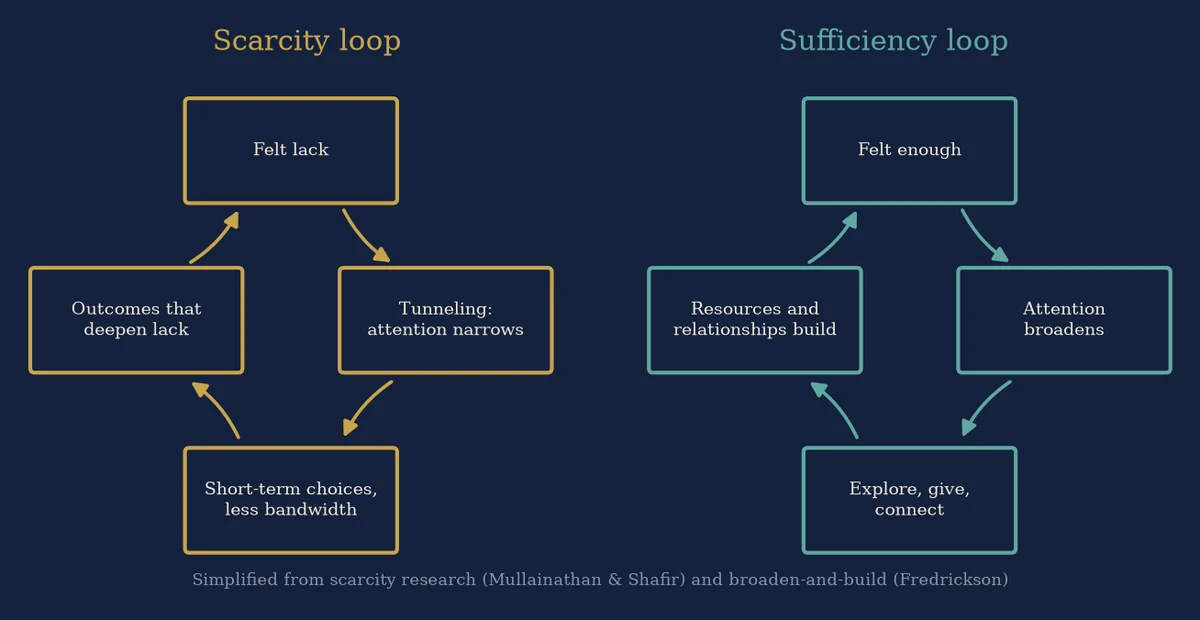
Mullainathan and Shafir describe two sides of this capture. The first is focus. A looming deadline can make a person remarkably efficient. They call this the "focus dividend." The second side is what they call tunneling. Attention narrows onto the urgent shortage, and everything outside the tunnel fades: long-term plans, health, relationships, even the next shortage coming down the road.
The cost of tunneling, in their account, is a "bandwidth tax." Bandwidth is their everyday word for two mental resources that psychologists measure in the lab. One is cognitive capacity, the ability to solve problems and hold information in mind. The other is executive control, the ability to plan, pay attention and resist impulses. Scarcity, they argue, uses up some of both, leaving less for everything else.
The shopping-mall and sugarcane studies
The best-known test of this idea appeared in Science in 2013. Anandi Mani, Sendhil Mullainathan, Eldar Shafir and Jiaying Zhao ran two kinds of study.
In the first, shoppers at a New Jersey mall were asked to think about a hypothetical car repair. For some, the bill was small, about $150. For others, it was large, about $1,500. They then did standard tests of reasoning and cognitive control. When the bill was small, poorer and richer participants performed about the same. When the bill was large, poorer participants performed noticeably worse. Thinking about a money problem they could not easily solve seemed to take up mental room.
In the second study, the team followed sugarcane farmers in India. These farmers receive most of their income once a year at harvest, so the same person is relatively poor before harvest and relatively well-off after it. The same farmers scored better on cognitive tests after harvest than before. The authors argued that this ruled out the idea that the result was only about who is poor. It was about the state of being short.
The authors compared the size of the drop to losing a full night's sleep and to a loss of roughly 13 IQ points on the reasoning test, while stressing that this did not mean poor people are less capable. Their point was the reverse: anyone placed under that load would show the same effect.
Borrowing against tomorrow
An earlier paper by Anuj Shah, Sendhil Mullainathan and Eldar Shafir in Science (2012), titled "Some Consequences of Having Too Little," used lab games to give people more or fewer resources. Participants who were made "poor" in a game focused harder on each round and sometimes did better in the moment. They were also more likely to borrow from future rounds at a poor rate, and overall that borrowing hurt them. The researchers saw this as a small-scale model of payday loans and late fees: attention locked on today makes tomorrow's cost hard to see.
The debate around the findings
The scarcity studies drew close attention, including criticism. In a published comment in Science (2013), Jelte Wicherts and Annelies Scholten questioned the statistical approach of the mall studies, in particular the way income was split into "rich" and "poor" groups, and argued that the evidence was weaker than presented. Mani and colleagues replied defending their analysis. Later research groups have tried to repeat the scarcity effects with mixed results, with some finding similar patterns and others finding smaller or no effects.
Within this debate, two things are widely accepted. First, financial stress and worry are real and common burdens that track with poorer health and harder decisions. Second, attention is limited, and a worry that keeps pulling at it leaves less for other tasks. The exact size of the "bandwidth tax," and how reliably a short lab prompt produces it, remains under study.
Why this matters for "being abundant"
In the scarcity researchers' framing, the inner state is not a reward for having resources. It is part of the machinery that decides what happens next. A mind under scarcity is not lazy or foolish. It is busy. That busyness, in turn, shapes choices that feed back into the outer situation.
Mullainathan and Shafir did not conclude that people can simply think their way out of poverty. Their recommendations were mostly practical: build slack into budgets and schedules, design programs and forms that demand less bandwidth, and automate good choices so they do not depend on a tired mind. Their point was that the inside and the outside of scarcity are tied together, so relief on either side can help the other.
Part 2: The "Enough" State
Maslow: deficiency and growth
Abraham Maslow's 1943 paper "A Theory of Human Motivation," in Psychological Review, laid out what became known as the hierarchy of needs. Physiological needs come first, then safety, then love and belonging, then esteem, and finally what Maslow called self-actualization: becoming more fully what one is capable of becoming.
Maslow did not draw the famous pyramid himself. That image came later, from others who taught his ideas. He also wrote that the order is not rigid and that people can be partly satisfied at several levels at once.
In later work, especially Toward a Psychology of Being (1962), Maslow drew a line between "deficiency" motivation and "growth" or "being" motivation. Deficiency motivation is driven by what a person lacks: hunger, fear, loneliness, wanting to be approved of. Growth motivation comes from a person who feels basically secure and is moving toward something because it is meaningful, not because they are filling a hole. Many later writers on abundance and scarcity mindsets borrow this distinction, often without naming Maslow.
Modern researchers have tested parts of Maslow's model with mixed results. A large study by Louis Tay and Ed Diener (2011) across many countries found that people's needs did predict their well-being, but that the needs did not have to be met in strict order for people to benefit from the higher ones. In other words, people living with material hardship could still gain from love, respect and meaning.
Self-determination theory: three basic needs
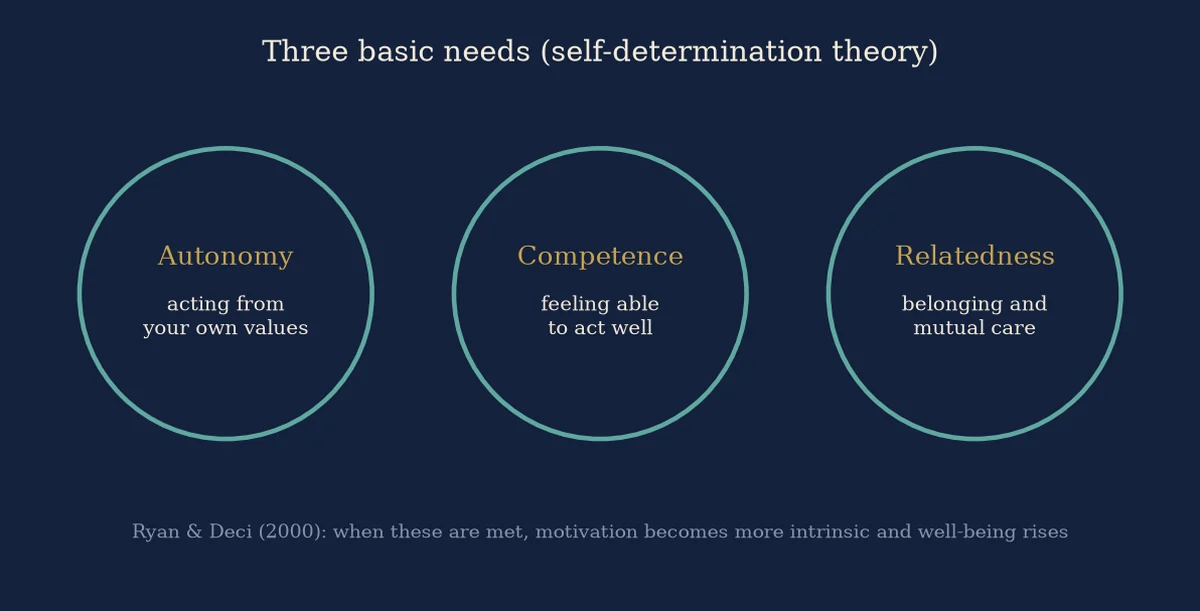
Edward Deci and Richard Ryan developed self-determination theory (SDT) from the 1970s onward. Their 2000 paper in American Psychologist summarized it. SDT says that people have three basic psychological needs:
- Autonomy: feeling that your actions come from your own values and choices.
- Competence: feeling able to act effectively and grow in skill.
- Relatedness: feeling connected to and cared for by others, and caring for them.
When these needs are supported, Deci and Ryan found, people tend toward intrinsic motivation, doing things for their own sake, and show greater well-being and persistence. When the needs are thwarted, people tend toward controlled motivation, acting from pressure, guilt or the search for reward.
The dark side of chasing money
One branch of SDT research looked at what people aim for. In 1993, Tim Kasser and Richard Ryan published "A Dark Side of the American Dream" in the Journal of Personality and Social Psychology. They found that people who rated financial success as more central to their lives than other goals, such as close relationships, personal growth and community, tended to report lower well-being and more signs of distress.
Kasser and Ryan did not claim that money is harmful. Their finding was about priority. When money becomes the dominant aim, it tends to crowd out goals that meet the three basic needs. People in that state can earn more and still feel short. This line of work is one reason psychologists draw a distinction between material abundance and a felt sense of abundance.
Broaden and build
Barbara Fredrickson's broaden-and-build theory, set out in American Psychologist in 2001, gives a different angle on the "enough" state. Fredrickson observed that negative emotions such as fear and anger tend to narrow what she called a person's "thought-action repertoire." Fear prepares you to flee. Anger prepares you to fight. That narrowing is useful in danger.
Positive emotions such as joy, interest, contentment and love, she proposed, do the opposite. They broaden attention and thinking, making people more open to new information, play and connection. Over time, the broader behavior builds lasting resources: skills, friendships, knowledge and resilience. Those resources then make future positive states more likely, creating what Fredrickson called an upward spiral.
In her framing, positive emotion is not just a pleasant byproduct of good circumstances. It is part of the process that builds good circumstances. That mirrors, in reverse, the scarcity researchers' description of tunneling.
Fredrickson's broad theory is widely cited. Some specific studies associated with it have been challenged. A well-known 2005 paper by Fredrickson and Marcial Losada proposed a precise "positivity ratio" of about 2.9 positive to negative emotions as a tipping point for flourishing. In 2013 Nicholas Brown, Alan Sokal and Harris Friedman published a critique showing that the mathematics behind the ratio did not hold. The ratio part of the paper was formally withdrawn. Fredrickson accepted that the specific ratio should be set aside while maintaining that the broader evidence for broaden-and-build stands on its own.
Gratitude: counting blessings
Robert Emmons and Michael McCullough published one of the first controlled experiments on gratitude in 2003, in the Journal of Personality and Social Psychology. The paper was titled "Counting Blessings Versus Burdens."
In their first study, participants were randomly assigned to write each week, for ten weeks, about things they were grateful for, about hassles, or about neutral life events. The gratitude group rated their lives as better overall, felt more optimistic about the coming week, reported fewer physical complaints and spent more time exercising than the hassles group. Follow-up studies in the same paper, using daily entries and a group of people with neuromuscular disease, found related benefits including more positive mood and, in the patient group, better reported sleep.
A 2010 review by Alex Wood, Jeffrey Froh and Adam Geraghty in Clinical Psychology Review pulled together the growing gratitude literature. They described gratitude as part of a wider life orientation toward noticing and appreciating the positive. They reported that grateful people tend to have higher well-being and better relationships, and that gratitude interventions show promise. They also cautioned that many intervention studies were small and that comparison conditions differed, which made the size of the benefit hard to pin down.
Later meta-analyses have generally found that gratitude exercises produce small but real improvements in well-being, often smaller than the early studies suggested and sometimes no larger than other positive activities.
Hedonic adaptation: why more rarely feels like enough
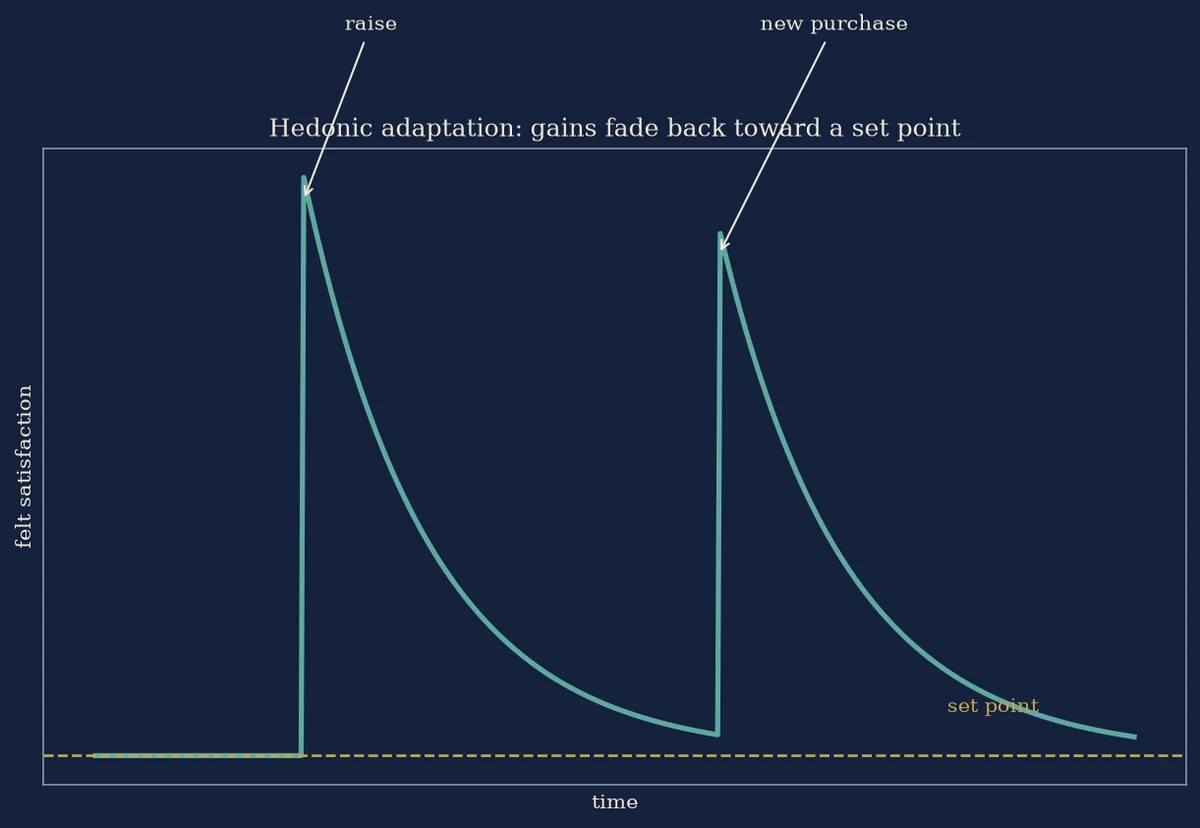
The "enough" state runs into a well-known obstacle: people adapt. In 1978, Philip Brickman, Dan Coates and Ronnie Janoff-Bulman published "Lottery Winners and Accident Victims: Is Happiness Relative?" They compared people who had recently won large lottery prizes with people who had not, and with people who had been paralyzed in accidents. The lottery winners were not significantly happier than the comparison group overall, and they reported taking less pleasure in ordinary daily activities.
The study was small, and later work has refined its message. People do not fully adapt to everything. Some events, such as long-term disability or unemployment, can shift well-being for years. But the core idea, called hedonic adaptation or the hedonic treadmill, is well supported: the lift from a raise, a new car or a bigger house tends to fade as it becomes the new normal.
Does money buy happiness?
The question has a long history in economics. For years, a widely quoted 2010 study by Daniel Kahneman and Angus Deaton was read as saying that emotional well-being stops rising at around $75,000 of yearly income in the United States.
In 2021, Matthew Killingsworth published "Experienced Well-Being Rises With Income, Even Above $75,000 Per Year" in PNAS. Using real-time reports collected by phone app, he found that well-being kept rising with income, with no plateau.
Kahneman and Killingsworth, with Barbara Mellers acting as a mediator, then carried out what is known as an adversarial collaboration, a joint study by researchers who disagree. Their 2023 PNAS paper, "Income and Emotional Well-Being: A Conflict Resolved," found that for most people, happiness keeps rising with income. For the least happy fifth of people, however, happiness rose with income up to around $100,000 a year and then leveled off. In that group, the authors suggested, the sources of unhappiness were ones that more money does not fix.
For the abundance question, these results cut both ways. More money is linked to more well-being for most people. But the shape of that link depends on the person's inner situation, and the least happy gain the least from extra income at the top end.
Part 3: Giving, Reciprocity and the Generous Mind
Spending money on others
In 2008, Elizabeth Dunn, Lara Aknin and Michael Norton published a short paper in Science titled "Spending Money on Others Promotes Happiness." They combined a national survey, a study of employees who received a bonus and a field experiment.
In the experiment, participants were given either $5 or $20 in the morning and told to spend it by 5 p.m. Some were told to spend it on themselves, for a bill or a treat. Others were told to spend it on someone else or give it to charity. That evening, the people who had spent the money on others reported greater happiness than those who had spent it on themselves. The amount, $5 or $20, made little difference.
In 2013, Lara Aknin, Christopher Barrington-Leigh, Elizabeth Dunn, John Helliwell and colleagues published "Prosocial Spending and Well-Being: Cross-Cultural Evidence for a Psychological Universal" in the Journal of Personality and Social Psychology. Using survey data from more than 130 countries, they found that giving to charity was linked to higher life satisfaction in most of them, in both rich and poor nations. They also ran experiments in Canada, Uganda and India. In those studies, people who recalled or carried out spending on others reported more happiness than those who spent on themselves.
Later replication efforts have generally found the warm effect of giving on mood, though sometimes smaller than in the first studies. Dunn and Norton's popular book Happy Money (2013) brought this research to a wide audience, arguing that how people spend matters as much as how much they have.
The brain on giving
William Harbaugh, Ulrich Mayr and Daniel Burghart studied giving inside a brain scanner. Their 2007 paper in Science gave participants money and then had some of it taken as a mandatory "tax" to a local food bank, while at other times participants could choose to give voluntarily.
Both kinds of transfer activated reward-related areas of the brain, areas also active when people received money themselves. Voluntary giving produced more activity than mandatory payment. The authors linked this to the economist's idea of a "warm glow," the pleasure of choosing to give, alongside a purely altruistic concern for the charity's welfare.
Spontaneous giving
In 2012, David Rand, Joshua Greene and Martin Nowak published "Spontaneous Giving and Calculated Greed" in Nature. In a series of economic games, people who decided faster tended to contribute more to a shared pool than people who took longer. When participants were pushed to decide quickly or told to rely on intuition, they cooperated more. When they were pushed to deliberate, they cooperated less.
The authors suggested that many people's intuitive default is cooperative, shaped by daily life where cooperation usually pays off. Later large replication efforts produced mixed results, and the effect of time pressure on giving is now considered smaller and less reliable than the original study suggested. The broader idea that intuition and deliberation can push giving in different directions is still being studied.
Givers, takers and matchers
The organizational psychologist Adam Grant, of the Wharton School, wrote Give and Take (2013), based on research on how people handle reciprocity at work. He describes three broad styles:
- Givers, who tend to help others without keeping close score.
- Takers, who try to get more than they give.
- Matchers, who try to keep an even balance of give and take.
Grant reported a pattern that surprised many readers. In several kinds of work, including engineering, sales and medical school, givers were overrepresented at the bottom of performance measures. They gave so much that their own work suffered. But givers were also overrepresented at the top.
The difference, in Grant's account, lay in how they gave. The successful givers were what he called "otherish." They cared about others but also kept an eye on their own interests. They set boundaries, chose where help would have the most impact, and were wary of takers. In Grant's framing, generosity paired with self-respect tends to build networks of trust and goodwill that pay back over time, often in unexpected ways.
Why generosity might feel like abundance
Taken together, these findings describe a loop. Giving tends to lift mood, at least in the short term. People who give are often seen as trustworthy, which tends to strengthen their relationships. And acting generously can itself send a signal, to the self as much as to others, that one has enough to share. Dunn and Norton have noted that giving seems to work best when people can see the impact of their gift, feel connected to the person helped and give freely rather than out of pressure, three conditions that line up with the SDT needs of relatedness, competence and autonomy.
Part 4: Belief, Expectation and Behavior
The luck factor
The psychologist Richard Wiseman, at the University of Hertfordshire, spent years studying people who described themselves as unusually lucky or unlucky. He summarized the work in The Luck Factor (2003).
In one experiment Wiseman has described, he gave people a newspaper and asked them to count the photographs inside. Unlucky people tended to take a couple of minutes. Lucky people often took seconds. On the second page, a large message told readers that there were 43 photographs in the newspaper and that they could stop counting. Many unlucky participants missed it. Many lucky participants saw it.
Wiseman's interpretation was that self-described lucky people were not receiving more chances. They were more relaxed and open, which made them more likely to notice chances that were already there. Unlucky people, in his account, were more anxious and focused narrowly on the task at hand, which made them miss what lay outside it.
He identified four principles that, in his view, lucky people tend to follow:
- They create, notice and act on chance opportunities.
- They listen to their intuition.
- They expect good fortune, which helps them persist.
- They turn bad luck into good by looking for what can be salvaged and taking steps to improve things.
Wiseman also ran what he called a "luck school," in which participants practiced these habits. He reported that many said they felt luckier afterward. This work was published mainly in his book and popular articles rather than in large controlled trials.
Locus of control
In 1966, the psychologist Julian Rotter published a monograph in Psychological Monographs on what he called internal versus external control of reinforcement. People with a more internal locus of control tend to believe that their own actions shape what happens to them. People with a more external locus tend to believe that outcomes depend mostly on luck, fate or powerful others.
Decades of later research have linked a more internal locus of control with better health habits, academic outcomes and coping. Researchers have also cautioned that the link runs both ways. People who have more control in their lives, through money, education or social position, also tend to feel more in control. An internal locus is partly a product of circumstances, not only a cause of them.
Self-efficacy
Albert Bandura's 1977 paper in Psychological Review, "Self-Efficacy: Toward a Unifying Theory of Behavioral Change," introduced self-efficacy: a person's belief in their ability to carry out the actions needed to reach a particular goal. Bandura distinguished it from general self-esteem. A person can feel good about themselves overall and still doubt they can give a public talk, and the reverse.
Bandura proposed four main sources of self-efficacy:
- Mastery experiences: succeeding at a task, especially after effort.
- Vicarious experiences: seeing someone similar succeed.
- Verbal persuasion: being encouraged by others.
- Physiological and emotional states: how a person reads their own arousal, tension or calm.
People with higher self-efficacy for a task, Bandura found, tend to choose harder goals, try harder and persist longer after setbacks. Of the four sources, he regarded mastery experiences as the strongest. In this framing, belief in yourself is built mostly by doing things and succeeding at them, step by step.
Growth mindset and its debates
The Stanford psychologist Carol Dweck's research on mindsets, popularized in her book Mindset (2006), distinguishes a "fixed mindset," the belief that abilities like intelligence are set, from a "growth mindset," the belief that they can be developed with effort, strategy and help.
A classic 1998 study by Claudia Mueller and Carol Dweck, in the Journal of Personality and Social Psychology, found that children praised for being smart after a task were more likely afterward to avoid challenges, to lose enjoyment after failing and to perform worse than children praised for their effort. Dweck's work suggested that how people understand ability shapes whether they treat setbacks as threats or as information.
Mindset research is now one of the most debated areas in education psychology. In 2018, Victoria Sisk, Alexander Burgoyne and colleagues published two meta-analyses in Psychological Science. They found that the overall link between mindset and academic achievement was weak, and that mindset interventions had small average effects, with some benefit concentrated in students from lower-income families or those at risk of failing.
In 2019, David Yeager and a large team including Dweck published a study in Nature of a short online growth-mindset program given to a nationally representative sample of US ninth-graders. The program produced small improvements in grades among lower-achieving students, and the effect was larger in schools whose peer culture supported challenge-seeking.
In 2023, two meta-analyses appeared together in Psychological Bulletin. Brooke Macnamara and Alexander Burgoyne concluded that, after accounting for study quality and possible bias, the evidence that growth mindset interventions improve academic achievement was weak. Jeni Burnette and colleagues, analyzing much of the same literature with a different approach, concluded that the interventions do help, especially for certain groups and when well implemented. The two teams agreed that effects are, on average, small. They disagreed about how meaningful and dependable those small effects are.
Self-fulfilling prophecy
The sociologist Robert K. Merton introduced the phrase "self-fulfilling prophecy" in a 1948 essay in The Antioch Review. He defined it as a false definition of a situation that calls up new behavior that makes the original false idea come true. His best-known example was a bank run. A sound bank can fail if enough depositors believe it will fail and rush to pull out their money.
In the 1960s, Robert Rosenthal and Lenore Jacobson studied expectations in classrooms. In their book Pygmalion in the Classroom (1968), they reported that when teachers were told that certain randomly chosen students were about to "bloom" intellectually, those students, especially in the youngest grades, later showed larger gains on IQ tests. Rosenthal and Jacobson argued that teacher expectations had shaped how teachers treated these children.
The Pygmalion study was heavily criticized for its methods, and attempts to repeat it produced mixed results. In 2005, Lee Jussim and Kent Harber published a major review in Personality and Social Psychology Review. They concluded that teacher-expectation effects are real but usually small, tend to fade over time, and may be stronger for students from stigmatized groups. They also found that teacher expectations are usually accurate predictions of student performance rather than its main cause.
What this cluster suggests about abundance
Seen together, these lines of research describe how belief can shape outcomes through behavior. Expecting good fortune, believing one's actions matter, trusting one's ability, believing growth is possible and being expected to succeed by others can each change what people notice, try and persist in. Researchers in all these areas emphasize that the effects work through action, attention and social response, and that most are modest on average. None of them describes beliefs changing outcomes without a behavioral pathway.
Part 5: Ancestors, Traditions and the Law of Attraction
The original affluent society
In 1966, at the "Man the Hunter" conference in Chicago, the anthropologist Marshall Sahlins presented the idea he later published as "The Original Affluent Society," part of his book Stone Age Economics (1972). Drawing on field studies of the Ju/'hoansi (often called the !Kung San) of the Kalahari and of Aboriginal Australians in Arnhem Land, he argued that hunter-gatherers met their material needs with relatively modest hours of work and lived with considerable leisure.
Sahlins framed affluence as a relationship between wants and means:
"There are two possible courses to affluence. Wants may be 'easily satisfied' either by producing much or desiring little."
He called the first the "Galbraithean way," the route of market economies that assume infinite wants and try to close the gap through ever-greater production. The second he called the "Zen road":
"Adopting the Zen strategy, a people can enjoy an unparalleled material plenty—with a low standard of living. That, I think, describes the hunters."
In Sahlins's account, scarcity is not a fixed feature of the material world. It is a relationship that depends on what a society wants and how it organizes access. The hunters he described carried few possessions, because mobility made heavy goods a burden, and showed little interest in storing up wealth. Sahlins saw this not as deprivation but as a different and in some ways freer economic logic.
Critiques of the affluent hunter
Sahlins's essay became one of the most influential in anthropology, and also one of the most criticized. Later researchers argued that the original work-hour estimates left out large amounts of food processing, tool making and other labor. They also pointed to evidence of seasonal hunger, high child mortality and periods of hardship in many foraging groups.
In 2000, the anthropologist David Kaplan published "The Darker Side of the 'Original Affluent Society'" in the Journal of Anthropological Research. Kaplan reviewed the data and argued that the case for leisure-rich foragers had been overstated. He concluded that hunter-gatherers often worked longer than Sahlins suggested and lived closer to the edge of nutritional stress. He also noted that the "limited wants" interpretation could be read as a romantic projection.
Defenders of Sahlins have replied that his central point, that how people think about wants shapes how affluent they feel, survives even if the work-hour figures do not. The debate continues, with researchers on both sides agreeing that foraging life was neither paradise nor constant struggle.
Sharing as insurance
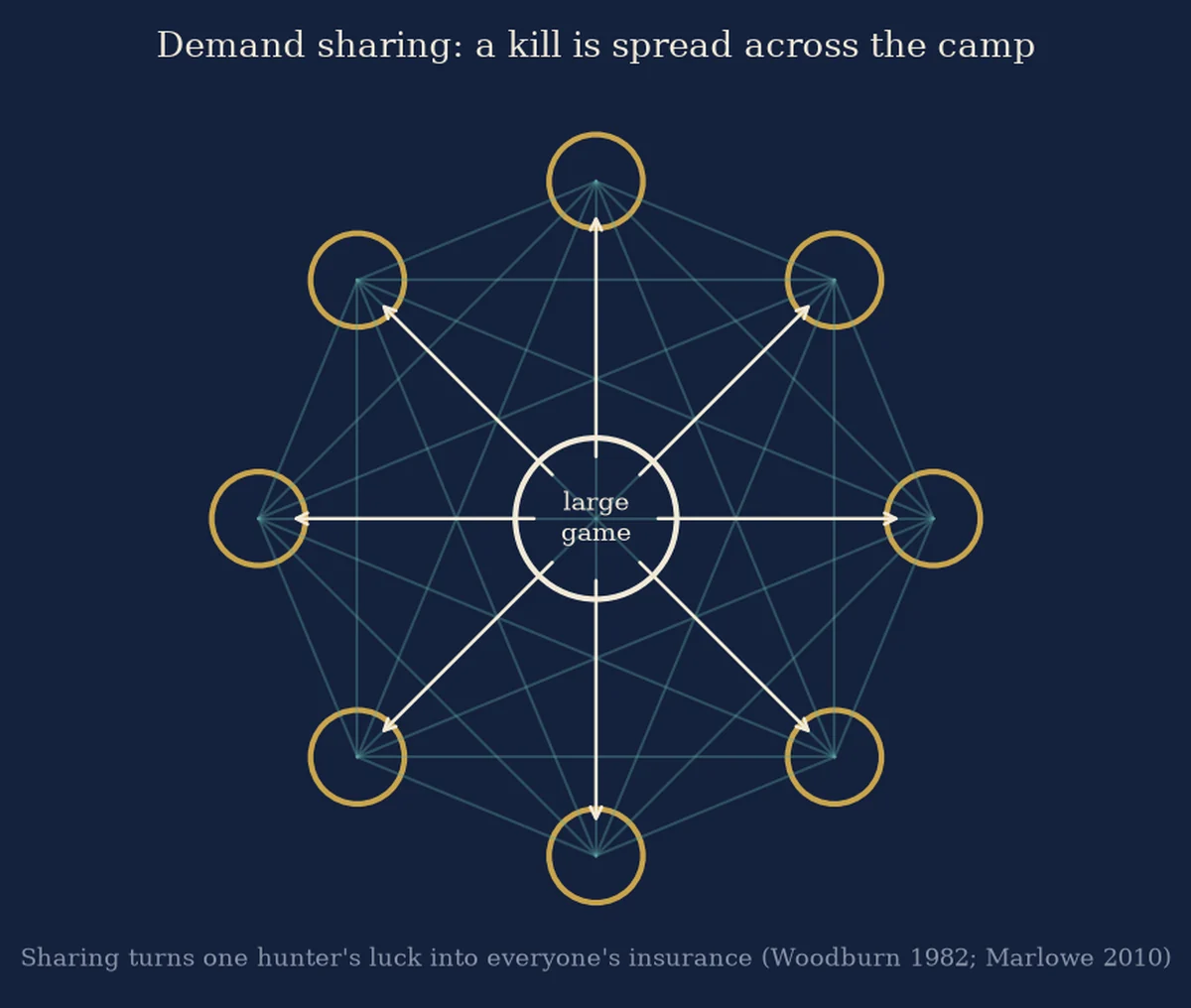
Whatever the exact work hours, anthropologists broadly agree that sharing sits at the center of many foraging societies. In 1982, the anthropologist James Woodburn published "Egalitarian Societies" in Man. He described "immediate-return" societies, among them the Hadza of Tanzania and the !Kung, where food is eaten soon after it is gathered rather than stored, and where strong norms push people to share and keep anyone from accumulating power or wealth.
The anthropologist Frank Marlowe, in The Hadza: Hunter-Gatherers of Tanzania (2010), described how meat from large game is distributed widely across a camp, often with the hunter having little control over who gets what. Researchers have described this practice as "demand sharing": people openly ask for a share and are expected to give it.
Ecological anthropologists explain this sharing partly as insurance. Big-game hunting is risky. Any one hunter may come home empty-handed for days. By sharing every kill across the camp, families smooth out the luck of individual hunters. A person who gives meat today can count on receiving it later. In this framing, a group's abundance comes from the flow of goods between people as much as from any one person's store.
The Stoics: wealth as enough
Long before modern psychology, the Stoic philosopher Seneca wrote about the inner side of wealth. In the second of his Moral Letters to Lucilius, he discusses a line he attributes to Epicurus, that contented poverty is an honorable estate. Seneca adds, in Richard Gummere's 1917 Loeb translation:
"It is not the man who has too little, but the man who craves more, that is poor."
He goes on to ask what the proper limit to wealth is, and answers:
"It is, first, to have what is necessary, and, second, to have what is enough."
The Stoics did not reject wealth. Seneca was himself very rich. They argued that wealth used without attachment could be a tool for good, but that a person who depends on it for peace of mind is always at risk, because it can be lost. For them, the real wealth was a mind that did not need more to be at rest.
Contemplative and spiritual traditions
Many religious and contemplative traditions describe a link between giving and receiving, and between contentment and plenty.
In Buddhism, dāna, or generosity, is listed among the core practices on the path, and contentment, often described as wanting little, is presented as a form of wealth. Generosity is taught as a way to loosen attachment and craving, which Buddhist teaching identifies as a root of suffering.
In the Christian Gospel of Luke (6:38), Jesus teaches, in the King James Version: "Give, and it shall be given unto you." Many Christian thinkers have read this as a teaching about the spiritual and communal returns of generosity rather than a promise of personal financial gain. Others, especially in what is now called the "prosperity gospel," have read it as a promise of material reward.
In the Taoist Tao Te Ching, a frequently translated line in chapter 33 is usually rendered in English along the lines of saying that the one who knows they have enough is rich. Translations differ in wording.
Across these traditions, the shared theme is that the felt sense of enough and the willingness to give are tied to well-being, and in many cases to community bonds. They describe these as inner disciplines practiced over a lifetime rather than techniques for getting something.
New Thought and the law of attraction
A separate stream of ideas grew up in the United States in the nineteenth century, known as New Thought. Its early figures, including Phineas Quimby, taught that mental states shape physical health and life outcomes. In 1910, Wallace Wattles published The Science of Getting Rich, which presented wealth as the result of holding a clear mental image of what one wants with faith and gratitude. In 1937, Napoleon Hill's Think and Grow Rich became one of the best-selling self-help books of the century, mixing practical business advice with claims about the power of desire and belief.
In 2006, Rhonda Byrne's film and book The Secret brought these ideas to a mass audience under the name "the law of attraction." The book teaches that thoughts emit a kind of frequency or energy that draws matching experiences, people and things, so that focusing on what one wants, feeling as if one already has it, and expecting to receive it will bring it about. Some presentations link this to quantum physics, suggesting that consciousness shapes physical reality.
What the evidence does and does not support
Researchers who have looked at the law of attraction distinguish between parts that line up with established psychology and parts that do not.
Parts that overlap with mainstream findings:
- Attention follows what people care about and expect. People who are looking for opportunities are more likely to notice them, as in Wiseman's newspaper experiment.
- Positive emotion broadens attention and can build resources over time, as in Fredrickson's work.
- Gratitude practices modestly improve well-being.
- Belief in one's ability, and the expectations of others, can change behavior and persistence, as in Bandura's and Merton's work.
Parts that are not supported:
- There is no evidence that thoughts emit an energy or frequency that pulls matching objects or events toward a person independent of their behavior.
- Physicists have repeatedly explained that quantum mechanics does not imply that human thought shapes everyday events, and the quantum language in law-of-attraction books is not used in the sense physicists use it.
- Success stories told in support of the law of attraction are open to survivorship bias: people who visualized and did not succeed rarely write books.
Some research points in the opposite direction from a pure visualization approach. Gabriele Oettingen and Doris Mayer, in the Journal of Personality and Social Psychology (2002), distinguished positive expectations, judgments based on past experience that success is likely, from positive fantasies, idealized images of a desired future. In studies of people looking for jobs, hoping for romance and recovering from surgery, positive expectations predicted better outcomes. Positive fantasies predicted less effort and worse outcomes. Oettingen later developed a technique called mental contrasting, in which people pair the wished-for future with an honest look at the obstacles in the way.
In a 1999 study by Lien Pham and Shelley Taylor in Personality and Social Psychology Bulletin, students preparing for an exam were asked either to imagine getting a high grade or to imagine the process of studying. Those who imagined the process studied more and scored higher. Those who only imagined the outcome studied less and did slightly worse than a control group.
Some psychologists have also raised concerns about the flip side of the law of attraction. If good outcomes come from right thinking, then bad outcomes, such as illness or poverty, can seem to be the result of wrong thinking. Critics argue that this can lead people to blame themselves or others for circumstances outside their control. Supporters of the law of attraction often reply that their teaching is about empowerment and focus rather than blame.
Three Views on "Being Abundant"
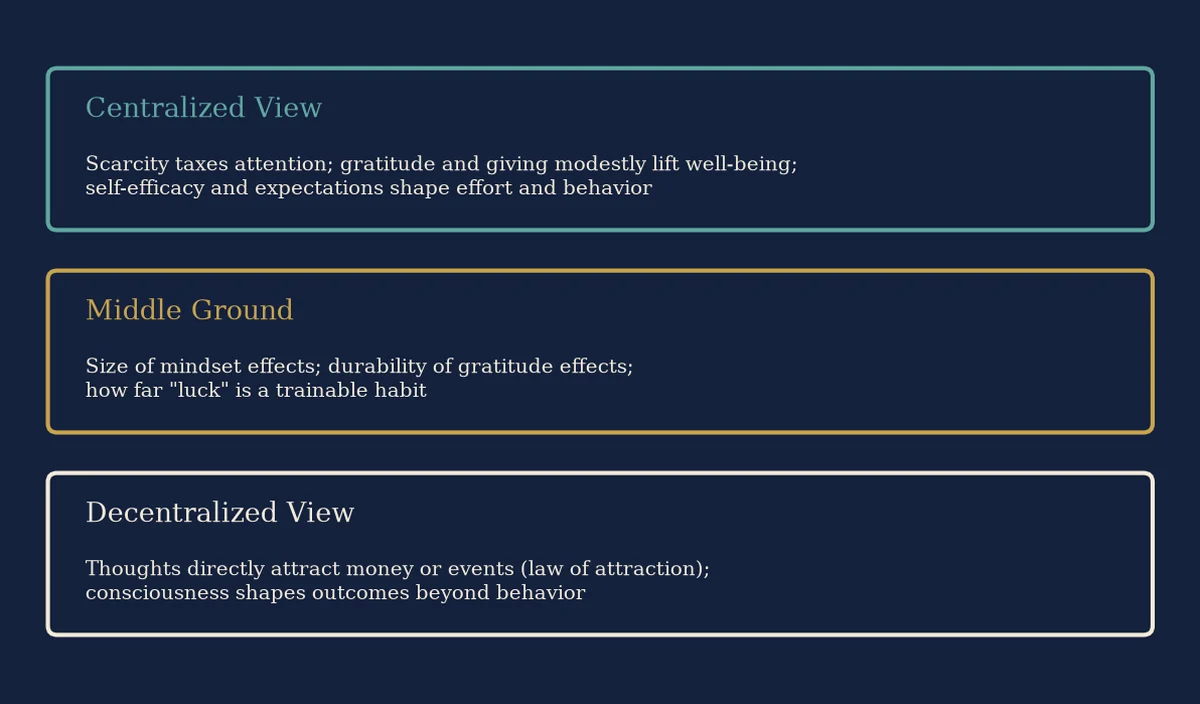
Centralized View: the established science
Centralized View
The mainstream picture in psychology, economics and anthropology is that inner states and outer resources shape each other through attention, emotion, behavior and relationships.
- Real scarcity, especially money worry, places a burden on attention and decision making.
- Hedonic adaptation means that gains in money or possessions lift well-being less, and for less time, than people expect.
- Income is linked to well-being for most people, but priorities matter: making money the central life goal is linked to lower well-being.
- Meeting the basic needs for autonomy, competence and relatedness supports motivation and well-being.
- Giving to others and gratitude practices reliably produce small boosts in mood and well-being.
- Self-efficacy, built mostly through mastery experiences, predicts effort and persistence.
- Expectations can be self-fulfilling, but the effects are usually modest and work through behavior.
- Many foraging societies rely on strong sharing norms that spread risk.
Middle Ground: active debate
Middle Ground
- How large and how reliable the "bandwidth tax" of scarcity is, given mixed replications.
- How much growth-mindset interventions change real outcomes, and for whom.
- How large and how lasting gratitude and prosocial spending effects are in daily life.
- Whether Wiseman's luck principles can be reliably trained.
- Whether intuitive decisions are more generous than deliberate ones.
- How affluent hunter-gatherers truly were, and whether "limited wants" describes their outlook or an outsider's projection.
Decentralized View: ideas not established
Decentralized View
- That thoughts and feelings send out a frequency that draws matching events, people or money toward a person (the law of attraction).
- That consciousness shapes physical events at large scales through quantum mechanisms.
- That visualizing a goal as already achieved will by itself bring it into being.
- That giving money will reliably bring a larger financial return to the giver through a universal law.
Supporters of these views often describe personal experiences of change after adopting them. Researchers in the Centralized View tend to explain such experiences through the mechanisms above: attention, mood, persistence, social response and selective memory.
The whole picture at a glance
| Idea | What it says | Level |
|---|---|---|
| Scarcity and bandwidth | Lack captures attention and taxes cognitive control | Centralized View, size debated (Mani 2013; Wicherts 2013) |
| Borrowing under scarcity | Focus on now leads to costly borrowing from later | Centralized View in lab games (Shah 2012) |
| Hierarchy of needs | Needs from survival to self-actualization; order is flexible | Centralized View in outline (Maslow 1943; Tay and Diener 2011) |
| Basic psychological needs | Autonomy, competence, relatedness support well-being | Centralized View (Ryan and Deci 2000) |
| Money as central goal | Linked to lower well-being | Centralized View (Kasser and Ryan 1993) |
| Broaden and build | Positive emotion widens attention and builds resources | Centralized View; ratio claim withdrawn (Fredrickson 2001) |
| Gratitude practice | Small improvements in well-being | Centralized View (Emmons and McCullough 2003) |
| Hedonic adaptation | Gains fade toward a set point | Centralized View (Brickman 1978) |
| Income and happiness | Rises for most; plateaus for least happy | Centralized View (Killingsworth 2021; Killingsworth, Kahneman and Mellers 2023) |
| Prosocial spending | Spending on others lifts happiness across cultures | Centralized View (Dunn 2008; Aknin 2013) |
| Warm glow | Voluntary giving engages reward areas | Centralized View (Harbaugh 2007) |
| Intuitive giving | Faster decisions more cooperative | Middle Ground (Rand 2012) |
| Givers, takers, matchers | "Otherish" givers rise to the top | Middle Ground (Grant 2013) |
| Luck as attention | Relaxed people notice more chances | Middle Ground (Wiseman 2003) |
| Locus of control | Internal locus linked to better outcomes | Centralized View (Rotter 1966) |
| Self-efficacy | Built mainly by mastery; predicts persistence | Centralized View (Bandura 1977) |
| Growth mindset | Small average effects; some groups benefit | Middle Ground (Sisk 2018; Yeager 2019; 2023 meta-analyses) |
| Self-fulfilling prophecy | Real but usually small, often fades | Centralized View (Merton 1948; Jussim and Harber 2005) |
| Original affluent society | Affluence by desiring little | Middle Ground (Sahlins 1972; Kaplan 2000) |
| Sharing norms | Immediate-return sharing spreads risk | Centralized View (Woodburn 1982; Marlowe 2010) |
| Fantasy versus expectation | Fantasies cut effort; expectations help | Centralized View (Oettingen and Mayer 2002; Pham and Taylor 1999) |
| Law of attraction | Thoughts attract matching outcomes | Decentralized View (Byrne 2006) |
| Quantum consciousness and wealth | Mind shapes reality at large scale | Decentralized View |
Not yet verified
These points have not been established, or were not checked against a primary source for this draft, and should be read as open questions:
- That thoughts or emotions attract events, people or money apart from behavior, or that quantum physics supports this.
- That giving reliably produces a larger financial return to the giver.
- The exact replication record of the 2013 scarcity studies (that later attempts were mixed is reported in secondary sources; specific replication papers were not opened for this draft), and the Mani team's published reply.
- The "13 IQ points" and "full night's sleep" comparisons (widely reported from the 2013 paper and its press materials; exact wording not re-checked).
- Tay and Diener (2011), Journal of Personality and Social Psychology, on needs and well-being around the world (details from secondary summaries; DOI not checked).
- The Fredrickson and Losada (2005) positivity ratio, the Brown, Sokal and Friedman (2013) critique, and the formal withdrawal of the ratio (standard account; papers not opened for this draft).
- The later meta-analyses on gratitude interventions and the replications of prosocial spending and intuitive giving (described in general terms from secondary sources).
- Kahneman and Deaton (2010) on the $75,000 figure (well known; paper not opened for this draft).
- Wiseman's newspaper experiment details, the four principles and the "luck school" results, taken from his own popular accounts, not a peer-reviewed paper.
- Adam Grant's findings on givers at the top and bottom, taken from his book rather than the underlying studies.
- Details of Rosenthal and Jacobson (1968) and of Maslow (1962), Wattles (1910), Hill (1937) and Byrne (2006), from standard histories.
- The term "demand sharing," usually credited to the anthropologist Nicolas Peterson (1993); the source was not opened for this draft.
- The 1966 "Man the Hunter" conference as the first presentation of Sahlins's essay, and the original Ju/'hoansi and Arnhem Land work-hour figures.
- The Tao Te Ching chapter 33 rendering and the Buddhist framing of contentment as wealth (paraphrased; no single translation was checked).
Key sources
- Mullainathan S, Shafir E (2013). Scarcity: Why Having Too Little Means So Much. Times Books.
- Mani A, Mullainathan S, Shafir E, Zhao J (2013). Poverty impedes cognitive function. Science 341:976–980. https://doi.org/10.1126/science.1238041
- Wicherts JM, Scholten AZ (2013). Comment on "Poverty impedes cognitive function." Science 342:1169. https://doi.org/10.1126/science.1246680
- Shah AK, Mullainathan S, Shafir E (2012). Some consequences of having too little. Science 338:682–685. https://doi.org/10.1126/science.1222426
- Maslow AH (1943). A theory of human motivation. Psychological Review 50:370–396. https://doi.org/10.1037/h0054346
- Ryan RM, Deci EL (2000). Self-determination theory and the facilitation of intrinsic motivation, social development, and well-being. American Psychologist 55:68–78. https://doi.org/10.1037/0003-066X.55.1.68
- Kasser T, Ryan RM (1993). A dark side of the American dream: Correlates of financial success as a central life aspiration. Journal of Personality and Social Psychology 65:410–422. https://doi.org/10.1037/0022-3514.65.2.410
- Fredrickson BL (2001). The role of positive emotions in positive psychology: The broaden-and-build theory of positive emotions. American Psychologist 56:218–226. https://doi.org/10.1037/0003-066X.56.3.218
- Emmons RA, McCullough ME (2003). Counting blessings versus burdens. Journal of Personality and Social Psychology 84:377–389. https://doi.org/10.1037/0022-3514.84.2.377
- Wood AM, Froh JJ, Geraghty AWA (2010). Gratitude and well-being: A review and theoretical integration. Clinical Psychology Review 30:890–905. https://doi.org/10.1016/j.cpr.2010.03.005
- Brickman P, Coates D, Janoff-Bulman R (1978). Lottery winners and accident victims: Is happiness relative? Journal of Personality and Social Psychology 36:917–927. https://doi.org/10.1037/0022-3514.36.8.917
- Killingsworth MA (2021). Experienced well-being rises with income, even above $75,000 per year. PNAS 118:e2016976118. https://doi.org/10.1073/pnas.2016976118
- Killingsworth MA, Kahneman D, Mellers B (2023). Income and emotional well-being: A conflict resolved. PNAS 120. https://doi.org/10.1073/pnas.2208661120
- Dunn EW, Aknin LB, Norton MI (2008). Spending money on others promotes happiness. Science 319:1687–1688. https://doi.org/10.1126/science.1150952
- Aknin LB, Barrington-Leigh CP, Dunn EW, Helliwell JF, et al. (2013). Prosocial spending and well-being: Cross-cultural evidence for a psychological universal. Journal of Personality and Social Psychology 104:635–652. https://doi.org/10.1037/a0031578
- Harbaugh WT, Mayr U, Burghart DR (2007). Neural responses to taxation and voluntary giving reveal motives for charitable donations. Science 316:1622–1625. https://doi.org/10.1126/science.1140738
- Rand DG, Greene JD, Nowak MA (2012). Spontaneous giving and calculated greed. Nature 489:427–430. https://doi.org/10.1038/nature11467
- Grant A (2013). Give and Take: A Revolutionary Approach to Success. Viking.
- Wiseman R (2003). The Luck Factor. Century / Miramax.
- Rotter JB (1966). Generalized expectancies for internal versus external control of reinforcement. Psychological Monographs 80(1):1–28. https://doi.org/10.1037/h0092976
- Bandura A (1977). Self-efficacy: Toward a unifying theory of behavioral change. Psychological Review 84:191–215. https://doi.org/10.1037/0033-295X.84.2.191
- Dweck CS (2006). Mindset: The New Psychology of Success. Random House.
- Mueller CM, Dweck CS (1998). Praise for intelligence can undermine children's motivation and performance. Journal of Personality and Social Psychology 75:33–52. https://doi.org/10.1037/0022-3514.75.1.33
- Sisk VF, Burgoyne AP, Sun J, Butler JL, Macnamara BN (2018). To what extent and under which circumstances are growth mind-sets important to academic achievement? Psychological Science 29:549–571. https://doi.org/10.1177/0956797617739704
- Yeager DS, Hanselman P, Walton GM, Murray JS, et al. (2019). A national experiment reveals where a growth mindset improves achievement. Nature 573:364–369. https://doi.org/10.1038/s41586-019-1466-y
- Macnamara BN, Burgoyne AP (2023). Do growth mindset interventions impact students' academic achievement? Psychological Bulletin 149:133–173. https://doi.org/10.1037/bul0000352
- Burnette JL, Billingsley J, Banks GC, Knouse LE, et al. (2023). A systematic review and meta-analysis of growth mindset interventions. Psychological Bulletin 149:174–205. https://doi.org/10.1037/bul0000368
- Merton RK (1948). The self-fulfilling prophecy. The Antioch Review 8:193–210. https://doi.org/10.2307/4609267
- Rosenthal R, Jacobson L (1968). Pygmalion in the Classroom. Holt, Rinehart and Winston.
- Jussim L, Harber KD (2005). Teacher expectations and self-fulfilling prophecies: Knowns and unknowns, resolved and unresolved controversies. Personality and Social Psychology Review 9:131–155. https://doi.org/10.1207/s15327957pspr0902_3
- Sahlins M (1972). The original affluent society. In Stone Age Economics. Aldine-Atherton.
- Kaplan D (2000). The darker side of the "original affluent society." Journal of Anthropological Research 56:301–324. https://doi.org/10.1086/jar.56.3.3631086
- Woodburn J (1982). Egalitarian societies. Man 17:431–451. https://doi.org/10.2307/2801707
- Marlowe FW (2010). The Hadza: Hunter-Gatherers of Tanzania. University of California Press.
- Seneca. Moral Letters to Lucilius, Letter 2. Trans. RM Gummere (1917), Loeb Classical Library.
- Oettingen G, Mayer D (2002). The motivating function of thinking about the future: Expectations versus fantasies. Journal of Personality and Social Psychology 83:1198–1212. https://doi.org/10.1037/0022-3514.83.5.1198
- Pham LB, Taylor SE (1999). From thought to action: Effects of process- versus outcome-based mental simulations on performance. Personality and Social Psychology Bulletin 25:250–260. https://doi.org/10.1177/0146167299025002010
- Byrne R (2006). The Secret. Atria Books / Beyond Words.
This article is for education only and is not financial, medical or mental health advice. Talk with a qualified professional about money decisions or about stress, anxiety or depression.
Better signals, less noise.
One email a week: the best threads on light, Earth cycles and sovereignty, with context, evidence labels and links to the original sources.
Thanks! You're on the list.
Sorry, something went wrong. Please try again, or reach us on X at @primal_buddha.
No spam. Unsubscribe anytime.